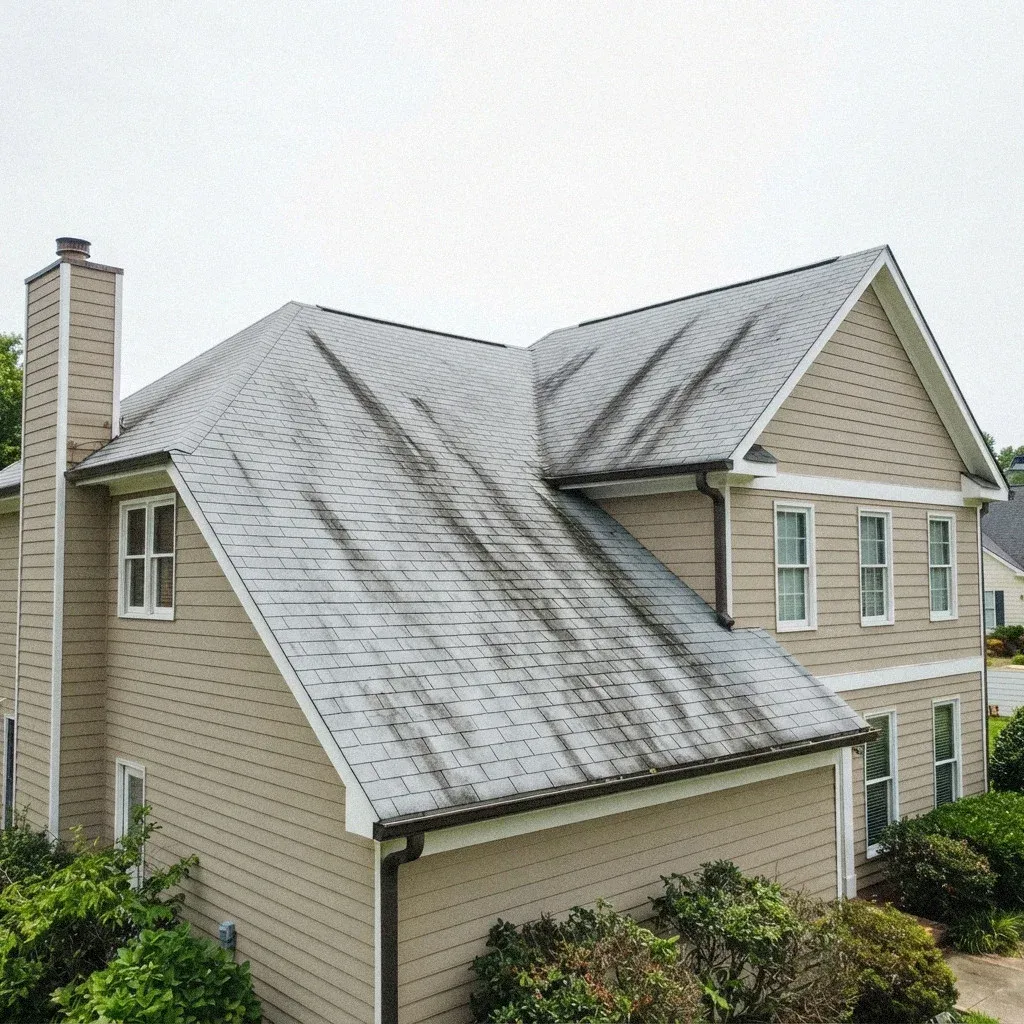
Dark Streaking on Shaded Omaha Roofs
Why shaded slopes near Dundee and Fairacres streak dark, and what actually clears it without shortening shingle life.
Omaha's roofs stay dry enough that thick moss rarely takes hold — the real issue is gloeocapsa magma, dark algae streaking on shaded north slopes near mature tree cover in Dundee or Fairacres, feeding on limestone granule filler after freeze-thaw winters loosen the surface.
What Gloeocapsa Magma Is and Isn't
Omaha's dry inland climate keeps moss and thick lichen mats rare here, but algae streaking still shows up on older roofs in Dundee and Benson, usually as gray-black smudges running down a north-facing slope. Gloeocapsa magma is the organism behind most of it, an airborne algae that settles on shingle granules and slowly discolors the surface. Douglas County's humid summers give it enough moisture to spread even without the heavier rainfall that drives moss growth farther east or west.
Shade load decides which roof plane gets hit first in an Omaha neighborhood. A slope shaded through most of the afternoon by mature trees common in Fairacres or Field Club stays damp longer after a spring rain, giving algae spores time to root in the granules before the sun dries the surface. A south-facing plane with open exposure toward West Dodge Road rarely shows the same streaking, even on an identical roof one street over.
Moisture retention is what separates a passing wet spot from an established colony. Once algae gets a foothold on a shaded plane, the granules hold a thin film of water longer after each Douglas County thunderstorm, and that extended dampness is what lets the colony spread rather than dry out and die back between rain events. A roof with good airflow across the deck resists this even under similar shade.
Why North Slopes Near Tree Cover Streak
Granules give up their grip once moss or algae sit on them long enough. Asphalt shingles carry a mineral coating that keeps sun exposure from breaking down the layer underneath, and constant moisture works that coating loose over time. On an Omaha roof, granule loss shows up first at the shingle edge, where shade from a tree canopy keeps the surface damp longest between rains and freeze-thaw cycling adds its own stress each winter.
Shingle edge lifting is less common with algae alone than with the heavier moss found in wetter climates, but it still turns up on shaded valleys and ridge caps in older Omaha housing stock where a thin mat has built up over several years. A lifted edge gives wind and driving rain a place to get underneath the shingle, and combined with the freeze-thaw cycling Omaha winters put every roof through, that small gap widens faster than it would on a warmer coast.
- Gloeocapsa magma is a single-celled organism, not a plant, that colonizes granule surfaces and feeds on limestone filler.
- Moss is a rootless plant needing sustained moisture to establish; it is uncommon on drier Omaha roof slopes.
- Lichen pairs a fungus with an alga and anchors into the granule surface rather than just staining it.
- Shade load, the daily hours a slope sits under canopy, sets how fast a colony spreads across shingles.
- Moisture retention is how long granules stay damp after a storm passes, the window spore or algae need to spread.
- North-facing slopes near mature canopy in Dundee or Benson dry slowest after freeze-thaw cycling loosens surface moisture.
How Streaking Wears Down a Shingle
Taking a pressure washer to an Omaha roof to clear algae streaking causes more trouble than the discoloration itself. A high-pressure stream drives water sideways under shingle laps and around flashing at chimneys and vent stacks, loosening granules the algae hadn't even reached yet and forcing moisture into spots that stay wet through the next freeze. On a home with a basement below, that extra water has to go somewhere, and gutters not built for it end up overwhelmed.
A soft wash approach uses a diluted sodium hypochlorite mix applied at low pressure through a garden-hose-style rig, then rinsed off once it has had time to break down the algae cells rather than blast them loose. The low-pressure rinse that follows carries the dead growth away without disturbing the granules or forcing water past the shingle laps, which is the whole reason the method works on an older Dundee or Benson roof where pressure washing would strip the surface bare.
- Streaking erodes the granule coating gradually, leaving bare asphalt underneath exposed to sun and freeze-thaw swings.
- Granule adhesion weakens fastest where a colony sits longest, usually low on a slope near the gutter line.
- Chimney flashing and vent stacks trap runoff longer, so discoloration and granule wear often start there first.
- None of this happens in a single season; it takes several Omaha winters of freeze-thaw cycling to show clearly.
Algae, Moss, and Lichen Compared
A zinc strip mounted near the ridge works on the same principle without any chemical application at all. Rain moving across the metal picks up trace ions and carries them down the slope every time it rains, and those ions make the surface less hospitable to new spores landing there. It won't touch algae already established lower on the roof, but on a home in Elkhorn or Millard with a fresh roof and heavy tree cover nearby, it buys years before streaking starts.
Algae-resistant shingles solve the problem from the manufacturing end. Copper compounds get mixed into the granules before the shingle ever reaches an Omaha roof, so protection isn't limited to a strip near the ridge the way a zinc or copper strip works. Homeowners in Elkhorn or Millard replacing a roof after hail damage sometimes ask about this option, and it's a reasonable question to bring to the licensed pros connected through this site.
| Growth | Look | Shingle Risk |
|---|---|---|
| Gloeocapsa magma (algae) | Dark gray-black streaks on shaded slopes | Feeds on granules, dulls the surface |
| Green-black streak pattern | Rarely establishes here, too dry | Minor edge lift if it does form |
| Gloeocapsa magma organism | Flat crusty rings, gray or pale green | Fused to granules, tears shingle surface pulling it off |
| Fresh streak, first season | Faint dark trail below the ridge line | Cosmetic, spreads with each spring rain |
| Removal approach | Soft wash with a sodium hypochlorite solution | Clears spores without stripping granule adhesion |
Soft Wash Versus a Pressure Washer
Tree canopy trimming addresses the real cause behind most Omaha algae problems, which is a roof plane that never fully dries out. Thinning branches that hang over a roof in Fairacres or near Elmwood Park lets more direct sun and airflow reach the shingles after a storm, cutting the hours the surface stays damp. It won't remove existing streaking, but it slows how fast new growth returns after a cleaning, which matters more than any one treatment applied once.
Deciding between tree work and a repeat cleaning schedule comes down to which slopes actually stay wet the longest, not just which ones look shaded from the street. A north-facing plane over a garage in Benson might dry within a day after rain while a valley near a chimney stays damp for three, and that second spot is where the money for canopy work pays off fastest rather than being spread evenly across the whole roof.
Zinc Strips, Copper, and Cutting Back Limbs
How often an Omaha roof needs attention for algae depends more on which trees surround it than on the shingle's age. A heavily shaded home near Memorial Park or Hanscom Park might need a soft wash every few years, while a roof with open exposure toward Interstate 680 can go a decade with barely a trace of streaking, even with the same shingle brand and installation date next door.
A fixed yearly schedule misses the point more often than it helps. Walking the yard to look up at the roof after the wettest weeks of an Omaha spring, and again once the leaves drop and shade patterns change for winter, catches new streaking while it is still a soft wash job rather than something that has had a full season to work into the granules and lift a shingle edge along the way.
What Actually Grows on an Omaha Roof
- Zinc and copper strips near the ridge shed metal ions with runoff, discouraging fresh growth on the shaded slope below over time.
- High-pressure equipment tears loose granules and drives water beneath tabs, leaving Omaha shingles worse off than the algae did.
- Copper strips near the ridge send metal ions downslope in runoff, slowing how fast a new colony spreads back.
- Algae-resistant shingle has copper granules mixed into the product, worth asking about if a reroof is already planned.
- Trimming canopy over a slope near Happy Hollow or Field Club cuts shade load and speeds up drying time.
- A spring check, after winter thaw and before summer storms, catches streaking early on shaded slopes.
Frequently Asked Questions
Will pressure washing ruin my shingles?
Not on its own. Algae streaking on an Omaha roof is mostly a discoloration problem and rarely causes a leak by itself. The concern is what it signals over time: granules staying damp longer than they should, which weakens their bond to the asphalt underneath. Left alone for years, especially through repeated freeze-thaw winters, that can shorten how long the shingle holds up, even without any moss ever forming.
What are those dark streaks on my roof?
Those streaks are a single-celled organism, gloeocapsa magma, colonizing granules on shaded slopes. It shows up heaviest on north-facing sections near tree cover in neighborhoods like Fairacres, where Omaha's freeze-thaw winters leave granules damp long after a spring thaw, giving the organism time to spread before the surface fully dries.
Is algae streaking actually damaging my shingles?
On its own, streaking is mostly a surface stain in its early stage, but left alone across several Omaha winters it wears down the granule coating and exposes asphalt underneath to UV and freeze-thaw stress. That shortens the shingle's remaining service life even without any lifted edges or trapped moisture involved.
How often does a shaded Omaha roof need cleaning?
A roof with open sun exposure in an area like Elkhorn can often go three or four years between cleanings. A north slope shaded by mature trees near Happy Hollow or Field Club may need a check every one to two years, since shade keeps granules damp longer after each rain or snowmelt.
Do zinc strips keep the streaking from returning?
Zinc and copper strips mounted near the ridge send trace metal into runoff with every rain or thaw, which slows how fast new algae colonies establish below them on the slope. They will not clean existing streaking off granules already colonized, so they work best paired with an initial soft wash treatment.
Want your streaking checked before it spreads?
Ask the licensed pros we connect you with to check streaking on your slope before granule loss spreads further.
Call (833) 566-1459