How an Omaha Reroof Actually Runs
The set order an Omaha reroof follows from signed contract to the final magnetic sweep of your driveway.
A full Omaha reroof follows a set order: scheduling and yard protection, tear-off, deck check and re-nailing, underlayment, flashing and pipe boot work, field shingles and ridge cap, cleanup, then a walkthrough punch list, with the licensed pros we connect you with handling each stage.
Locking In the Date and the Yard
A signed contract in Omaha sets a start window tied to crew scheduling, not a fixed calendar date, since hail season runs April through June and pushes demand across Douglas County all at once. Homes in Dundee, Benson, and Millard often land on the same rough week if a spring storm hit the whole metro. The licensed pros we connect you with confirm the window once materials are ordered, then narrow it as the date gets closer.
Property protection happens before tear-off starts, not after the first shingle comes off. Tarps cover landscaping and window wells, since Omaha's older homes on lots in Field Club or Morton Meadows often have basement egress windows close to the foundation that debris can damage. Gutters get temporary guards, and any patio furniture or grills near the drip line get moved. This step protects the yard and the foundation, not just the siding.
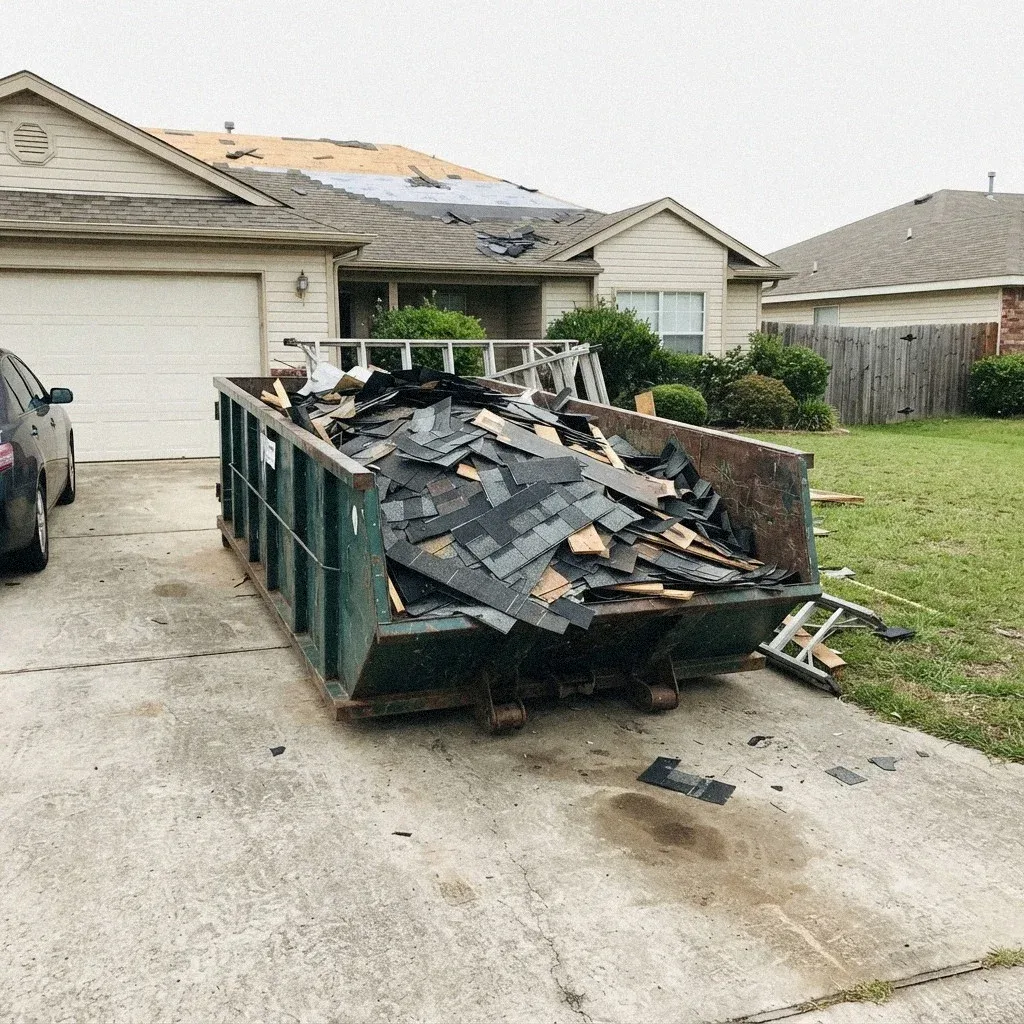
Two things worth settling before the date is set. Ask where the debris container will stand and whether the driveway can take it, because a loaded container has cracked more than one Omaha drive. And ask what happens if the forecast turns, since a tear-off started under a clear morning and finished under a thunderstorm is the one scenario that turns a reroof into an insurance claim on your own ceiling.
Tear-Off and What the Deck Reveals
Tear-off is loud, fast and messy, and it is also the only chance anybody gets to see the roof structure. The old covering comes off in sections rather than all at once, so the exposed deck is never larger than can be covered before the end of the day. On a two-layer roof this takes noticeably longer, which is why the layer count belongs in the quote.
What the deck reveals is the part no estimate can promise. Soft sheets get sounded and marked, then cut back to a rafter so the replacement lands on framing rather than floating between supports. Fasteners in sound decking get re-driven where the sheathing has lifted. Expect a call at this stage if more has turned up than the estimate allowed for, and expect it before the work is done rather than after.
- Scheduling gets locked in once the contract is signed, with the licensed pros we connect you with watching Omaha's spring hail pattern before committing a date.
- Property protection covers landscaping, window wells, and any basement egress near the foundation before a single shingle comes off the roof.
- Where the dumpster sits gets settled before work starts, since a Dundee alley or a Field Club driveway rarely leaves the same room to work with.
- Crews clear one slope at a time down to the deck, keeping the rest of the roof shingled and dry until that section's turn comes.
- Deck inspection checks every sheet of sheathing for rot or delamination, common on older Omaha homes where ice has backed up under the eaves for years.
- Deck re-nailing tightens fasteners that loosened over decades of freeze-thaw cycling, giving the new underlayment a solid, flat surface to seal against.
Underlayment, Flashing, Every Pipe Boot
Once the deck is sound, synthetic underlayment goes down in overlapping rows across the whole roof, sealing the plywood before a single shingle is set. This sheet is the roof's actual barrier against wind-driven rain, since shingles alone shed water but don't seal every gap on their own. Drip edge goes in along the eaves and rakes at this stage too, giving water a clean edge to leave the roof instead of running back under it.
Every penetration gets new material rather than reused material. Pipe boots are replaced as a matter of course, because the rubber is the shortest-lived part of a roof and reusing one puts a ten-year-old component under a new thirty-year roof. Step flashing at walls comes out and goes back in piece by piece, and counterflashing is let into the masonry rather than sealed onto the face of it.
- Synthetic underlayment covers the whole deck before the crew breaks for the day, since an Omaha afternoon can turn from clear to a downpour fast.
- Drip edge sets first along the eaves, then a starter course locks over it, giving runoff a clean edge to follow off the deck.
- Valley metal goes in wherever two roof planes meet, since Omaha's heavy spring downpours can overwhelm a valley that was not lined properly.
- Valley metal channels runoff where two roof planes meet, and a boot collar cinches tight around each stack so water tracks off, not in.
The Stack, Starter Course to Ridge
The stack is the order the layers go down in, and each one depends on the one before it. Ice and water shield at the eaves first, where meltwater backs up behind ice, then synthetic underlayment across the whole deck, then drip edge, then the starter course locking over it. Get the order wrong and the roof still looks finished from the ground, which is exactly why it matters.
The ridge cap goes on last and it is a separate product from the field shingles. It sits on the most visible line of the roof and it covers the ridge vent, so it is doing a job as well as finishing the look. A cap that does not match, or one nailed through the vent slot it is meant to protect, is the commonest thing to find wrong on an otherwise good roof.
| Layer | Step | Purpose |
|---|---|---|
| Deck check | Probe for soft spots, re-nail loose sheathing | Gives every later layer a solid surface |
| Deck Fastening | Synthetic sheet, drip edge, starter course | Backs up the shingles against wind-driven rain |
| Field and ridge | Shingles set in pattern, hip and ridge cap last | Locks the whole roof together at the top |
| Field shingles | Full-width courses up from the eave | Builds the weather surface row by row |
| Hip and ridge cap | Cut cap shingles over the ridge vent | Final piece, ties the field together at the peak |
Field Shingles and the Nailing Pattern
Field shingles go up in courses from the eave, each one offset from the last so the joints never line up over each other. The offset pattern is set by the manufacturer, and following it is what makes the roof shed water rather than channel it. It is also the difference between a roof that meets its warranty and one that quietly does not.
The nailing pattern is the part that decides how the roof behaves in Omaha wind. Manufacturers specify a number of nails per shingle and a nailing zone to put them in, and a high-wind pattern uses more. Too high and the nail misses the layer below; too low and it shows through. Ask which pattern is being used and whether the wind rating in the warranty depends on it.
Magnetic Sweep and the Final Punch List
A tear-off produces thousands of old nails and they go into the lawn, the flower beds and the driveway. A magnetic sweep is run over the whole property, more than once along the drive and around anywhere children or pets walk. It is the part of the job most often skimped, and the part homeowners notice weeks later with a flat tire.
Then the walkthrough, and it should happen with somebody rather than as a note through the door. Expect photographs of what was found and replaced, the permit and inspection record, the manufacturer warranty registration, and the workmanship warranty in writing with a length on it. Anything outstanding goes on a punch list with a date, agreed rather than assumed.
The Reroof in Order
- Everything starts with a signed scope: shingle brand, tear-off layers, dumpster placement, and which licensed pro handles each stage of the work.
- Property protection goes down first: tarps over landscaping and window wells, dumpster placement worked out for the lot.
- Tear-off strips old shingles and flashing to the deck, exposing soft spots or old damage before re-nailing begins.
- Deck re-nailing brings older fastening up to current standards, then synthetic underlayment covers the whole deck.
- Field shingles run eave to ridge, then hip and ridge caps close the peaks, with a ridge vent cut in if planned.
- Punch list wraps the job: crooked ridge vents, gaps in step flashing, or valley metal edges get fixed before the crew leaves.
Frequently Asked Questions
How many days does a full reroof usually take?
Two to three days on a typical Omaha house once material is on site, with the tear-off itself usually taking one. What extends it is what turns up under the old covering, a steep or cut-up roof with several valleys, or a second layer to remove. Weather is the other variable, since underlayment should not be left exposed over a wet night.
What happens if the roof deck is rotten?
Dumpster placement in Omaha depends on the lot and street. Older Dundee and Benson lots with narrow driveways often need the container set closer to the curb, while wider Millard and Elkhorn driveways usually fit it beside the garage. The pros we connect you with check clearance against fences, power lines, and low branches before drop-off.
Will the crew protect my driveway and yard?
Once tear-off strips a roof down to bare boards, the crew probes the deck for soft spots, delamination, and nail pull-through. Weak sections get cut out and replaced before deck re-nailing brings the whole surface up to a tighter nailing pattern. Skipping this step on an older Field Club or Benson home risks a shingle warranty that never holds.
What does a post-cleanup nail sweep actually accomplish?
A magnetic sweep drags a wheeled magnet across the driveway, walkway, and lawn after tear-off and cleanup to pull up stray roofing nails. Wind off Dodge Street or a sloped Happy Hollow yard can carry loose nails farther than expected, so a sweep runs before the crew calls the job finished, not just once.
What does the final walkthrough actually check?
A punch list is the short walkthrough tally after the field shingles, hip and ridge cap, and flashing are set. It might flag a crooked ridge vent, a gap in step flashing near a chimney, or valley metal that needs a cleaner seal. Any item found becomes a change order only if it adds real work beyond the original contract.
Ready to line up your Omaha reroof?
Have an Omaha reroof coming up? Tell us about your roof and we'll connect you with a licensed local pro.
Call (833) 566-1459