What Is Wrong With My Omaha Roof?
A ceiling stain in a Dundee bungalow after a spring thaw is not the same trouble as granules collecting in a Benson gutter following an April hailstorm. One usually points to a leak already inside the house. The other points to shingle wear that hasn't reached the attic yet, but could.
The honest way in is from what you saw rather than from a diagnosis. A brown ring, a cold draft, granules in the gutter, a sag along the ridge: each of those points somewhere different. Read the one that matches, and if two of them match, that is exactly what a free inspection is for.
Daylight showing through attic boards in an older Florence home, a sagging rafter line near Elmwood Park, or a soft spot by a Millard chimney each mean something different. Freeze-thaw cycling loosens flashing over years; a single hailstorm can crack a shingle field in an afternoon. What you're seeing narrows down which one happened.
Signs that need dealing with now
Either the water spreads fast, there is a contamination or structural risk, or acting late costs a great deal more.
| What you noticed | What it usually means | How soon it matters | Read more |
|---|---|---|---|
| A brown ring spreading on an upstairs ceiling | A brown ring means water has been getting past the roof and soaking into that spot for a while, not just once. In Omaha's older homes near Dundee or Benson, it often points to decking gone soft underneath — see roof decking damage. Leave it, and the ceiling itself can start to sag or give way. | Deal with it now | Soft and Delaminated Roof Decking |
| Water running down inside a wall after a storm | Water tracking down inside a wall after a storm points to failed step flashing where the roof meets a brick wall, common on Dundee and Field Club homes with chimneys or wall intersections. Water gets behind the brick and follows framing down, soaking insulation and drywall. Get it looked at now — this keeps happening every storm until the flashing is resealed or replaced. | Deal with it now | Step Flashing Failure at Brick Walls |
| A drip from the ceiling only when wind drives rain | Wind is pushing rain sideways into your ridge vents, past the baffles meant to keep weather out while still letting the attic breathe. Once it's past them, it lands on attic insulation and finds the ceiling below. This is a ridge vent problem, not a shingle failure, and it only shows itself when wind and rain hit together. | Deal with it now | Ask on the call |
| Shingles lying in the yard after a hailstorm | Whole shingles in the yard mean wind got under an edge, creased it, and tore it loose during the hailstorm — the tab is gone, not just dented. That spot on the roof is bare or nearly bare right now, so rain gets straight into the decking. Omaha wind events do this fast, and it only gets worse until the gap is covered. | Deal with it now | Wind-Creased and Torn Shingles |
| A hole punched through the roof by a branch | A branch punching through the deck means the roof's covering, sheathing, and often the framing underneath took a direct hit, opening a clear path for rain into the attic — expect daylight in the attic and stained decking near the break. Water follows joists fast, so a ceiling bulge or active drip can show up rooms away. This one's now, not soon; see debris-strike-punctures. | Deal with it now | Debris Strike Punctures |
| Ceiling sagging soft and heavy to the touch | A ceiling that feels soft, heavy, or spongy means water has soaked the decking above it long enough to break it down — the plaster or drywall is holding weight it was never built to carry. This is active structural failure, not staining. Stay out of the room and get the licensed pros we connect you with out to Omaha before it lets go. | Deal with it now | Soft and Delaminated Roof Decking |
| Water pouring in around the chimney | Water pouring in around the chimney means the crown or counterflashing has failed outright, not just cracked. This is an active-entry leak into homes across Omaha, from Dundee to Millard, and it will keep soaking ceiling drywall and attic framing with every rain until sealed. See chimney crown and counterflashing leaks. | Deal with it now | Chimney Crown and Counterflashing Leaks |
| A thick ice ridge sitting on the gutter | A thick ice ridge on the gutter means melted snow refreezing at the roof's edge, backing water up under the shingles above it. Once that ridge holds, the next thaw has nowhere to drain and starts working sideways under the roofing instead. See ice-dams-along-the-gutter-line. | Deal with it now | Ice Dams Along the Gutter Line |
| Water backing up under the shingles in a thaw | Water working back under the shingles during a thaw means ice at the eave dammed runoff, forcing it uphill under the roofing. It's active intrusion, not a slow seep, and it targets the eave membrane meant to block exactly this. Left alone it soaks decking and ceilings below. See the eave-membrane-failure-under-ice problems page. | Deal with it now | Ask on the call |
Signs worth booking an inspection for
Not an emergency, and not something to leave until next season either.
| What you noticed | What it usually means | How soon it matters | Read more |
|---|---|---|---|
| Dents across the gutters and the furnace vent cap | Dented gutters and a dinged furnace vent cap mean hail hit hard enough to deform metal, and shingles took the same beating even if you can't see it from the ground in Omaha. The vent cap seal can crack from the impact, and dented gutters may pull loose or overflow next rain. See hail-dented-roof-vents-and-caps. | Worth booking | Hail-Dented Roof Vents and Caps |
| Shiny black spots where the shingle grit is gone | Shiny black spots where the shingle grit is gone usually mean hail hit hard enough to bruise the mat underneath, not just scuff the surface. Bare asphalt sheds Omaha's Dodge Street sun and Elkhorn winters fast, and a bruised mat can crack open later. Worth a closer look before the next storm off the Missouri River finds the weak spot. | Worth booking | Hail Bruising and Mat Fracture |
| The cap shingles along the peak look lifted | Lifted cap shingles along the peak usually mean straight-line wind got under the nailing and popped the seal on that ridge line. Every gust after that works the gap wider, and a hard blow off the Missouri River corridor can peel a section clean off. Damage tends to spread each time it storms. | Worth booking | Ridge Cap Loss in Straight-Line Wind |
| Shingle corners curled up and creased | Curled, creased corners mean the shingle has taken repeated wind lift and lost its seal, common after gusty fronts blow through Omaha from Elkhorn to Millard. Each freeze-thaw cycle stiffens the mat more, so cracking and blow-off risk grows with the next storm. See wind-creased-and-torn-shingles. | Worth booking | Wind-Creased and Torn Shingles |
| Frost on the attic boards on a cold morning | Warm indoor air is leaking into a cold attic and freezing on the underside of the boards. Each thaw wets the sheathing, and repeated cycles through an Omaha winter can rot decking and grow mold. Check attic insulation and ventilation; see attic-frost-and-damp-sheathing. | Worth booking | Attic Frost and Damp Sheathing |
| Insulation in the attic feels damp | Damp attic insulation usually means moisture is getting trapped up there instead of venting out, often from poor airflow or a small roof leak feeding it during Omaha's freeze-thaw swings. Left alone, wet insulation stops insulating, invites mold, and can lead to stained decking below. Grows worse every rain until the source is found. | Worth booking | Attic Frost and Damp Sheathing |
| A cracked rubber collar around a roof pipe | A cracked rubber boot around a roof pipe means water can seep in wherever the collar splits, usually from repeated freeze-thaw cycling common in Omaha winters. It won't flood a room outright, but it feeds slow damage — stained decking, a water stain spreading across a ceiling, maybe a musty smell in the attic. It grows every rain until replaced, so don't wait on it. | Worth booking | Ask on the call |
| Rust streaks running down a roof valley | Rust means the valley metal is old or was scratched, and it's now holding moisture instead of shedding it, often with grit and shingle debris packed on top slowing the runoff further. Left alone through more Omaha freeze-thaw cycles, the metal thins and pits until water finds a seam. Watch for a matching stained decking or dark streak inside the attic below. | Worth booking | Ask on the call |
| Grit collecting at the bottom of the downspout | Grit collecting at the bottom of the downspout is shingle granule, and it means the shingles up top are wearing thin from years of Omaha's freeze-thaw cycling and hail. It threatens faster water absorption and shorter shingle life ahead. See the granule loss page for what usually causes it. | Worth booking | Ask on the call |
| Water marks around the edge of a skylight | Water staining ringing a skylight usually means the seal or curb flashing around it has failed, letting water track along the frame and into ceiling drywall. It can also point to condensation if there's no active leak. Left alone it spreads into a water stain or ceiling bulge. See skylight curb and seal leaks. | Worth booking | Skylight Curb and Seal Leaks |
| Paint peeling on the board behind the gutter | Peeling paint behind the gutter usually means water is spilling over or seeping behind it instead of running off, soaking the fascia board underneath. Left alone, damp wood invites rot, and rot behind the gutter can spread to the roof edge. Check the gutter for overflow or a loose downspout before it gets worse. | Worth booking | Ask on the call |
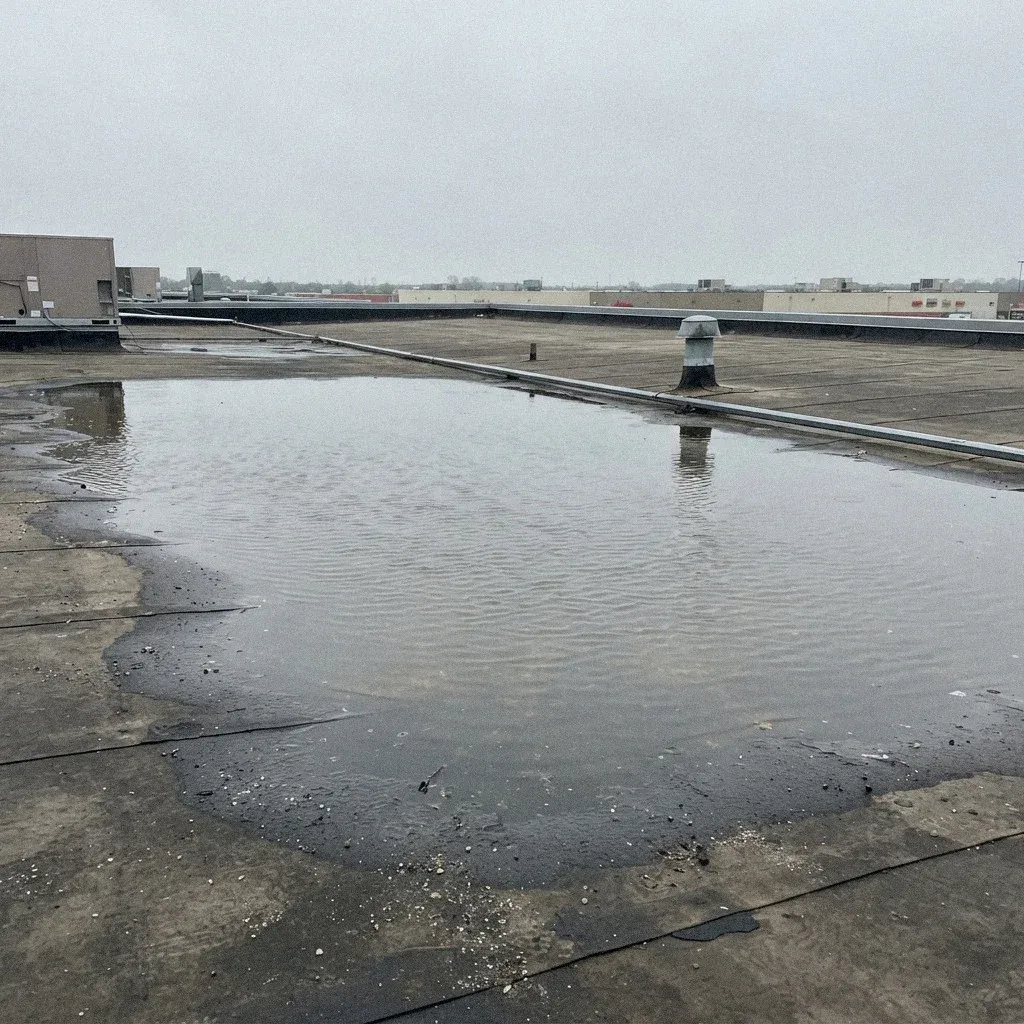
| A puddle still sitting on the porch roof days later | A puddle still sitting on the porch roof days after the rain means that low, flat section isn't shedding water the way a pitched roof over the rest of the house does. Standing water works into seams and fastener heads over time, and in an Omaha freeze-thaw cycle it can expand into cracks each winter. Left alone it usually turns into a ceiling stain or a soft spot in the decking below. | Worth booking | Ask on the call |
| Snow piled deep on the garage roof after a blizzard | Heavy snow sitting on a garage or porch roof after a blizzard adds weight these lower-pitched spans weren't always built to hold, especially older Omaha garages. Freeze-thaw cycling packs it into dense, heavy layers instead of letting it shed. Watch for sagging lines in the roof deck or creaking - that means clear it now, carefully, without climbing on top. | Worth booking | Ask on the call |
Signs to keep an eye on
Not damaging yet. Worth understanding before you spend money on it.
| What you noticed | What it usually means | How soon it matters | Read more |
|---|---|---|---|
| Nail heads showing as bumps through the shingles | Small bumps under the shingle surface are nail heads working loose as the roof deck flexes with temperature swings. It's usually cosmetic for now, but a popped nail head can eventually puncture the shingle above it, opening a path for water. Watch it after freeze-thaw cycles; if it turns into a lifted edge or a shingle in the yard, treat it as a fastening problem, not just a bump. | Keep an eye on it | Ask on the call |
| A dip you can see along the roof line from the street | A dip in the roof line seen from Dodge Street or your own driveway usually means the decking underneath has softened over the years, often from small leaks nobody caught. It's a slow problem, not an emergency, but it's worth a look before the sag deepens or spreads toward the flashing. | Keep an eye on it | Ask on the call |
| Rain spilling over the gutter instead of down the pipe | Rain spilling over the gutter instead of down the pipe usually means the gutter is packed with grit and leaf debris, or the run is pitched wrong so water never reaches the downspout. During an Old Market-style cloudburst it can also just be more rain than any gutter is sized for. Left alone, the overflow erodes soil near the foundation. See gutter and downspout problems. | Keep an eye on it | Gutter Overflow in Cloudburst Rain |
| The attic far hotter than outside in July | An attic far hotter than outside in July usually means soffit vents are blocked, so hot air has nowhere to escape near the roofline. Left alone, this bakes shingles from underneath and drives up cooling costs in homes across Omaha. It is not urgent like an active leak, just steady wear worth fixing before next summer. | Keep an eye on it | Ask on the call |
| A musty smell the moment the attic hatch opens | That is worth having looked at rather than watched. Anything you can see from the ground or from inside is already past the point where the roof was doing its job quietly, and on this kind of roof the cost of finding out is small next to the cost of the ceiling underneath. | Keep an eye on it | Attic Frost and Damp Sheathing |
| Daylight showing through the roof boards | Daylight coming through roof boards in the attic means the decking itself has rotted or delaminated enough to open gaps, usually from long-term moisture soaking through from above. It's slow-building damage, not an emergency, but it will worsen with each Omaha freeze-thaw cycle and eventual rain. See soft, delaminated roof decking. | Keep an eye on it | Soft and Delaminated Roof Decking |
Frequently Asked Questions
What does it mean if I see a brown ring spreading on an upstairs ceiling?
A brown ring means water has been getting past the roof and soaking into that spot for a while, not just once. In Omaha's older homes near Dundee or Benson, it often points to decking gone soft underneath — see roof decking damage. Leave it, and the ceiling itself can start to sag or give way.
What does it mean if I see water running down inside a wall after a storm?
Water tracking down inside a wall after a storm points to failed step flashing where the roof meets a brick wall, common on Dundee and Field Club homes with chimneys or wall intersections. Water gets behind the brick and follows framing down, soaking insulation and drywall. Get it looked at now — this keeps happening every storm until the flashing is resealed or replaced.
What does it mean if I see a drip from the ceiling only when wind drives rain?
Wind is pushing rain sideways into your ridge vents, past the baffles meant to keep weather out while still letting the attic breathe. Once it's past them, it lands on attic insulation and finds the ceiling below. This is a ridge vent problem, not a shingle failure, and it only shows itself when wind and rain hit together.
What does it mean if I see shingles lying in the yard after a hailstorm?
Whole shingles in the yard mean wind got under an edge, creased it, and tore it loose during the hailstorm — the tab is gone, not just dented. That spot on the roof is bare or nearly bare right now, so rain gets straight into the decking. Omaha wind events do this fast, and it only gets worse until the gap is covered.
What does it mean if I see a hole punched through the roof by a branch?
A branch punching through the deck means the roof's covering, sheathing, and often the framing underneath took a direct hit, opening a clear path for rain into the attic — expect daylight in the attic and stained decking near the break. Water follows joists fast, so a ceiling bulge or active drip can show up rooms away. This one's now, not soon; see debris-strike-punctures.
What does it mean if I see ceiling sagging soft and heavy to the touch?
A ceiling that feels soft, heavy, or spongy means water has soaked the decking above it long enough to break it down — the plaster or drywall is holding weight it was never built to carry. This is active structural failure, not staining. Stay out of the room and get the licensed pros we connect you with out to Omaha before it lets go.
What does it mean if I see water pouring in around the chimney?
Water pouring in around the chimney means the crown or counterflashing has failed outright, not just cracked. This is an active-entry leak into homes across Omaha, from Dundee to Millard, and it will keep soaking ceiling drywall and attic framing with every rain until sealed. See chimney crown and counterflashing leaks.
What does it mean if I see a thick ice ridge sitting on the gutter?
A thick ice ridge on the gutter means melted snow refreezing at the roof's edge, backing water up under the shingles above it. Once that ridge holds, the next thaw has nowhere to drain and starts working sideways under the roofing instead. See ice-dams-along-the-gutter-line.
What does it mean if I see water backing up under the shingles in a thaw?
Water working back under the shingles during a thaw means ice at the eave dammed runoff, forcing it uphill under the roofing. It's active intrusion, not a slow seep, and it targets the eave membrane meant to block exactly this. Left alone it soaks decking and ceilings below. See the eave-membrane-failure-under-ice problems page.
What does it mean if I see dents across the gutters and the furnace vent cap?
Dented gutters and a dinged furnace vent cap mean hail hit hard enough to deform metal, and shingles took the same beating even if you can't see it from the ground in Omaha. The vent cap seal can crack from the impact, and dented gutters may pull loose or overflow next rain. See hail-dented-roof-vents-and-caps.
Not Sure What You're Seeing
A brown ring spreading across a bedroom ceiling in Midtown, shingle grit turning up in a gutter after a spring windstorm, a musty smell settling into an attic near the Elkhorn River - each points toward a different cause and a different urgency. Matching the symptom to the likely source here saves a homeowner from paying for an inspection aimed at the wrong part of the roof.
Call (833) 566-1459