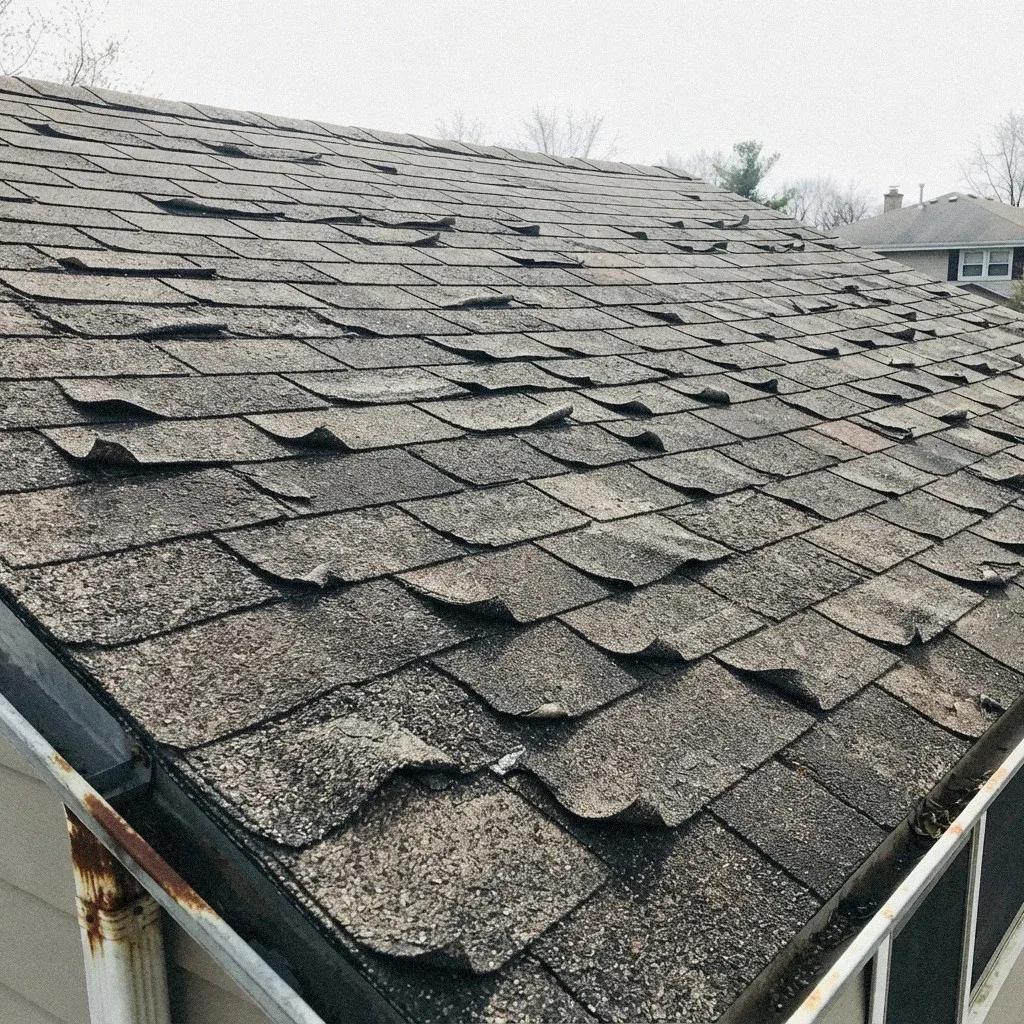
The Aging Timeline Of An Omaha Shingle Roof
Omaha shingle roofs move through predictable stages between installation day and the last hailstorm they survive.
Rated life is the number printed on the shingle bag, often 25 or 30 years. Achieved life is what Omaha's hail, freeze-thaw cycling, and summer heat actually deliver, commonly 15 to 22 years depending on install quality, ventilation, and slope exposure.
What The Bag Says Versus What Omaha Delivers
A bag of shingles stamped with a thirty-year rating tells you what a lab produced under heat lamps and controlled cycling, not what happens on a roof over Dundee or Benson. Omaha shingles face spring hail, summer humidity, and January lows that regularly sit near 17 degrees. That swing between hot and cold does work no laboratory schedule replicates, so achieved life on an Omaha roof almost always lands well short of the number printed on the wrapper.
The gap between the two numbers is not the manufacturer being dishonest. A rated life assumes an installation that follows the specification exactly, a ventilated attic, and weather that does not include being hailed on twice. Omaha supplies wide temperature swings, strong straight-line wind and hail, and the shingle wears at the rate those conditions set rather than the rate the laboratory did.
Which slope you are looking at changes the answer as well. A south or west face in Omaha takes far more direct sun over twenty years than the north side of the same roof, and the shingles there will be visibly further along. That is why a roof can genuinely need one slope replaced and the others left, and why a whole-roof age is only ever an average.
How A Roof Changes Across The Decades
A roof ages in stages rather than steadily, and knowing which stage you are in is more useful than knowing the year it went on. The early years are about the roof settling into itself. The middle years are when weather starts taking granules. The late years are when the mat underneath begins to lose flexibility, and that is the point where repairs stop being economic.
What moves a roof between stages faster than anything is heat from underneath. An attic that cannot breathe holds summer heat against the deck for months, and the shingle bakes from the back where nobody can see it. Two identical roofs on the same Omaha street, one ventilated and one not, will not reach the same age together.
- First five winters: nail heads settle, sealant strips finish their bond under summer heat, and granule color still looks even across the slopes.
- Years six through twelve: repeated freeze-thaw cycling through Omaha winters starts loosening granules on south and west slopes exposed to the most direct sun.
- Years thirteen through eighteen: tab edges begin curling as summer heat and sudden temperature drops flex the fiberglass mat, especially on older Dundee and Benson homes.
- Years nineteen through twenty-four: cracking spreads through valleys, nail pops surface near ridge lines, and hail bruising from past spring storms compounds normal aging.
- Years twenty-five and beyond: blistering, wind-lifted tabs, and bare patches near Missouri River-side neighborhoods signal the shingle has reached its end of service life.
- End of service life shows up as several failures at once — bald patches, curled tabs, and cracked sealant strips together, no longer just isolated wear.
Losing Granules And Losing Grip
Granules are not decoration. They are the layer that stops sunlight reaching the asphalt, and once they thin the mat below starts to break down in earnest. That is why a shiny or slick-looking patch on a slope matters more than it looks: the roof there is no longer protected, and the rest of the slope is a few years behind it.
Losing grip is the other half of aging, and it happens at the sealant strip. Each shingle is bonded to the one below by a band of adhesive that softens in summer heat and re-bonds. As the shingle stiffens with age that bond gets weaker, and a wind that would have done nothing at year eight lifts tabs at year eighteen. That is why wind damage clusters on older roofs.
- Achieved life rarely matches rated life once install quality is uneven — nail placement, pattern spacing, and sealant strip contact all shape how long a roof actually holds up.
- Attic ventilation governs how much heat builds under the deck each summer, and homes across Elkhorn and Millard with undersized soffit or ridge vents see faster mat aging.
- Gutters and valley flashing decide how fast roofs dry after downpours; homes near Papillion Creek or the Missouri River often carry heavier debris load and slower runoff.
- Pitch and tree cover change drying speed between rain events, with low-slope sections in Dundee or Benson holding moisture longest under mature shade canopy.
Cupping, Clawing, And Curling Explained
Cupping, clawing and curling get used interchangeably and they mean different things. Cupping is the corners lifting so the shingle holds a dish shape, usually from heat and age. Clawing is the middle of the shingle lifting while the edges stay down, which points at moisture from below. Curling is the general term for either, and it is the one used loosely.
Telling them apart is worth doing because they point at different causes. Cupping across a sunny slope on an older roof is ordinary aging. Clawing on a north slope, or on a roof only twelve years old, points at an attic that is holding moisture, and replacing the shingles without fixing that gets you the same problem on a newer roof.
| Warp Pattern | Looks Like | Likely Cause |
|---|---|---|
| Years 1 to 5 | Tab edges lift, center stays flat | Sealant strip not yet fully bonded |
| Years 6 to 15 | Whole tab cups, granules bare at high points | Freeze-thaw stress on an aging fiberglass mat |
| Years 8 to 15 | Edges lift while the center stays flat | Repeated freeze-thaw cycling pulling the mat |
| Years 15 to 22 | Whole shingle claws inward at both corners | Sun-baked fiberglass mat losing flexibility |
| Clawing at tab corners | Corners curl inward while center stays flat | Failing sealant strip after repeated freeze-thaw cycles |
What A Roof Near The End Looks Like
No shingle outlasts a bad install, regardless of its rated life. In Omaha that means fasteners driven at the right height, enough nails per shingle to hold through spring wind events, and courses run straight so water sheds the way the shingle was designed to shed it. A roof over a Papillion or La Vista house installed with high nails or too few fasteners per shingle will show nail pop and lifted tabs a decade before a properly fastened roof on an identical house nearby.
A roof near the end announces it in several places at once, which is the real signal. Granule loss across the field rather than in patches, tabs curling on more than one slope, several nail pops, a soft area or two underfoot, and a repair history that has crept up to one visit a year. Any one of those is a repair. All of them together is a roof.
Naming The Point Of No Return
The point of no return is not a date, it is the moment repair stops being cheaper per year than replacement. Divide what a repair costs by the years it honestly buys, and compare that with a reroof divided by twenty. Once the repair figure is the larger of the two, every further repair is money spent twice, however small each one looks.
Two things move that point earlier in Omaha. A discontinued shingle line means every future repair is visible, which turns a technical decision into a cosmetic one. And a roof that has already been through a hail event has less mat strength left than its age suggests, so the next storm does more. Neither shows up in a simple age calculation.
Fast Checks For Aging Shingles
- Rated life on paper assumes ideal install and ventilation; Omaha's freeze-thaw swings and hail exposure routinely cut achieved life below the rated number.
- Sealant strips need summer heat to bond tabs down; a roof installed late in an Omaha fall may see its first real bonding delayed into spring.
- Fresh factory granules wash off within the first year or two and mean nothing. Bare patches showing black mat a decade in mean real wear.
- Poor attic ventilation traps heat under the deck, accelerating mat aging from underneath even when the shingle surface still looks intact.
- Framing shifts and hot-cold cycling push nail heads up over time, not a bad batch of fasteners, and each one opens a tiny gap for water.
- Bare mat showing through worn granules, cracked tabs in valleys, or curled edges catching wind mean the roof is past rated life.
Frequently Asked Questions
What's the real lifespan of asphalt shingles in Omaha?
Commonly fifteen to twenty-two years for an architectural asphalt roof here, against a rated life of twenty-five or thirty. Hail is the biggest single reason for the gap, followed by heat trapped in a poorly ventilated attic. A well-ventilated roof that has not been hailed on can reach its rated life; one that has been hailed on twice usually does not.
Does Omaha weather age shingles faster than the rated life?
Not heat cycling like the Sun Belt sees. In Omaha, shingles wear from winter freeze-thaw stressing the sealant strip and granules, plus spring hail bruising the fiberglass mat before wear ever shows on the surface. A three-tab shingle in Millard or an architectural shingle in Elkhorn ages the same way here: cold makes the mat brittle, then April storms crack what the cold already weakened.
Why are my shingle edges curling after just a few years?
Rated life assumes steady ventilation, a dry deck, and correct nailing. Older Benson and Dundee homes with tight attics trap heat that speeds granule loss and clawing at the tab edges, while poor drainage near a roof valley holds water long enough for wind uplift to catch a loosened edge. Skip a step during install and the shingle falls short of its rated years regardless of brand.
Does granule loss in the yard mean my roof is failing?
No. Granule loss alone is normal shedding, especially in the first year after installation as loose granules wash off in Omaha's spring rain. It becomes a real concern when bare asphalt shows in patches on a slope, paired with cracking near valleys or edges lifting along the ridge.
Can bad attic ventilation shorten how long shingles last?
Often, yes. Attics with blocked soffit vents or undersized ridge vents trap summer heat against the deck, which speeds blistering and shortens sealant strip life from underneath. Older homes in Dundee and Benson with additions or finished attic space are frequent candidates for a ventilation check during a roof inspection.
Wondering What Stage Your Roof Is In?
Curious where your Omaha shingles fall on this timeline? Describe the age and wear, and the licensed pros we connect you with can size it up.
Call (833) 566-1459