Small Gaps That Turn Into Big Repairs
Omaha's older blocks in Benson, Florence, and parts of Midtown still carry original three-tab from decades when it was the standard composition shingle, long before architectural shingle became the usual reroof pick.
It stays the lowest-cost composition shingle option for a plain gable roof, which is why it still turns up on rental housing and budget reroofs across South Omaha and older Millard.
Half of what shortens an Omaha roof happens under it. Warm air rising from a full basement and a heated house collects in the attic, and if the soffit intake is blocked it has nowhere to go, so it bakes the deck in July and condenses on it in January. Two roofs on the same street, one venting properly and one not, will not reach the same age together.
Choosing Materials That Hold Up
- Service Life
- Fifteen to twenty years is typical in Omaha, shorter than an architectural shingle, since freeze-thaw cycling dries and rewets the flat mat every winter.
- Roof Weight
- A three-tab course is among the lightest asphalt coverings, a plus on older Dundee or Benson framing never sized for a heavier tile or slate load.
- Minimum Slope
- Manufacturers set a 2:12 minimum with proper underlayment beneath it; anything flatter sheds Omaha's spring downpours too slowly and calls for a membrane instead.
- Walkability
- Walkable in dry weather for a gutter check or a post-hail look, but the flat tab surface turns slick fast once moss builds up on a shaded slope.
- Repair Method
- Repairing a three-tab roof means lifting the tab above, working the damaged shingle loose from its nail line, and fitting a fresh one to match the exposure.
- Season
- Omaha's reroof window narrows outside spring through fall; a three-tab job pushed into winter fights sub-freezing temperatures that keep sealant strips from bonding the new course properly.
- Usual range
- an estimated $11000–$30000
Why Hail Damage Hides Until Spring
Three-tab gets confused with architectural shingle, since both start as a flat asphalt mat before the factory adds a layer. Architectural shingle laminates a second layer onto the mat, building a shadow line and extra thickness that three-tab skips entirely. That laminate is also where the shingle's higher wind rating comes from, which three-tab's single ply doesn't carry.
Matching New Material to an Existing Roof
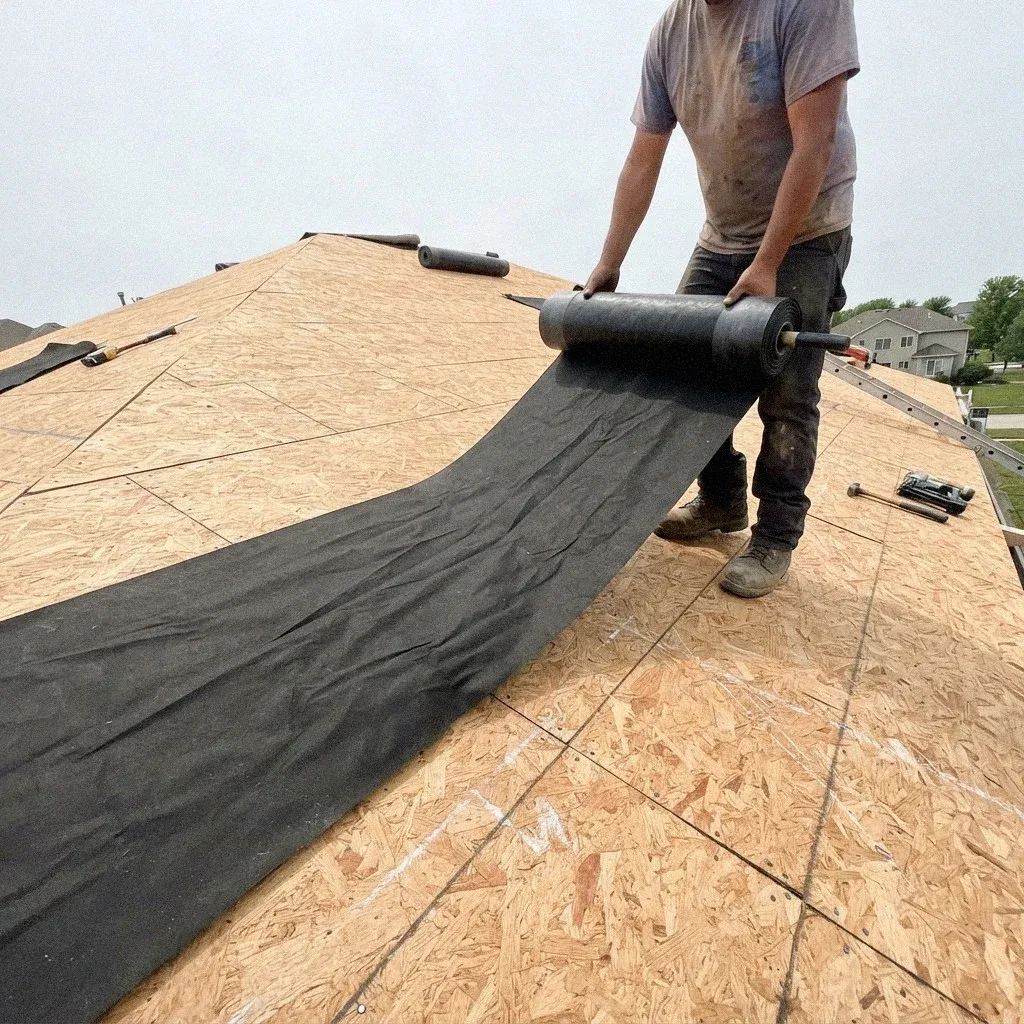
A three-tab shingle roof is torn off down to the deck so the boards can be checked for soft spots, then new felt or synthetic underlayment goes down before fresh starter strip and courses of shingles are nailed on. In Omaha, Dundee and Benson bungalows carry this covering well on simple gable roofs.
Where the deck is dry and flashing still seals, some Omaha homeowners reroof over one existing three-tab layer to hold down cost. Most licensed pros we connect you with will still recommend a tear-off first, since a hidden second layer often voids the shingle's wind rating.
Freeze-thaw cycling does most of the quiet damage to a roof here. Water works into small cracks, freezes, expands, and repeats through winter until flashing lifts and shingles crack. That slow wear rarely shows from the ground. The licensed pros we connect you with check for it during any inspection, not just after a storm makes the damage obvious.
INSURANCE CLAIM TIMELINE VS. OUT-OF-POCKET REPAIR TIMELINE
| What It Means |
Years Before Replacement |
|---|
| Omaha roofs deal with hail more than wind-driven rain, and that changes what actually fails first. Granule loss from an April hailstorm weakens a shingle without opening it up right away, so the damage sits unnoticed until a freeze-thaw winter finds the weak spot and turns it into a leak. | Insurance adjusters here see enough hail claims each spring that they know the difference between wind-lift and hail bruising on sight. A homeowner walking into that conversation without their own read on the roof is negotiating a repair bill blind, against someone who does this every week. |
| A roof claim gets complicated fast when the homeowner, the adjuster, and the contractor all read the same shingles differently. Getting a second, licensed opinion before signing anything keeps the estimate grounded in what the roof actually needs, not what any one party wants it to need. | Freeze-thaw is the quiet damage here, not the dramatic kind. Water works into small gaps, freezes, expands, and widens them, then thaws and does it again the next week. A shingle edge or flashing seam that could handle one hard freeze rarely holds up through a whole winter of them. |
| Hail doesn't always leave a hole you can see from the driveway. It can bruise a shingle's mat without breaking the surface, and that bruise keeps losing granules long after the storm passes. An insurance adjuster or a roofer trained to spot bruising can tell the difference between cosmetic marks and real functional damage. | Gutters matter more here than in drier places, because so many older homes have a finished basement below grade. A roof that sheds water poorly doesn't just risk the attic — it can push water toward a foundation that was never built to take it. Drainage is part of the roof's job. |
Permit ThresholdsA straightforward tear-off may not always need a City of Omaha Planning Department permit, but a full reroof generally does, and the exact scope threshold isn't published by the city, so it's worth confirming before work starts.
Gutters, Basements, and Where Water Goes
Age on a three-tab roof shows up as curling corners, bare patches where granules have worn through, and moss lift along the tab seams. All three routes end the same way: water finding a gap and reaching the deck below.
Checking Your Own Roof From The Ground
Replacing one cracked tab yourself is doable if the roof pitch is low and you can stand on it safely, but blending faded granule color and re-sealing flashing at a chimney or valley trips up most first-timers. Millard and Elkhorn homeowners often hand this off rather than risk a leak.
What Freeze-Thaw Cycling Does to Shingles
There's no health risk in the shingle material itself. What matters is how quickly a leak under a lifted tab gets caught, since wet insulation over a finished basement ceiling in an older Omaha home turns into a mold problem fast.
Let's Get Your Roof On A Timeline
Putting right three-tab shingle roofs usually runs an estimated $11000 to $30000. That is a budgeting figure, not a price. Omaha's freeze-thaw cycling, not insect activity, drives most hidden roof damage found around Dundee and Benson. The eastern subterranean termite is the local species, entering through soil contact, but it rarely factors into a reroof estimate here. The licensed pros we connect you with usually flag ice-dam and flashing wear before pest damage. pricing guide, and the service that handles this is Roof Replacement.