Medical & Dental Offices
Healthcare Roofing
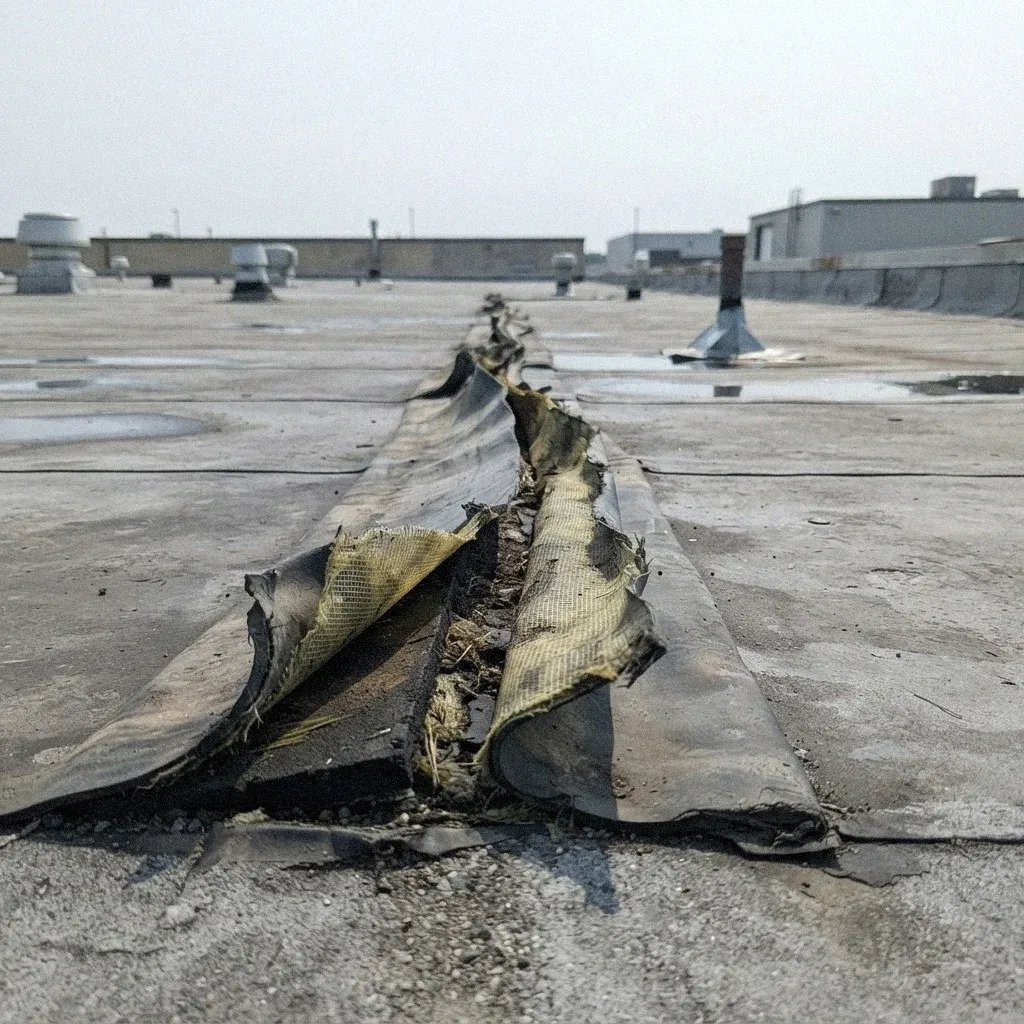
Section-by-section work across a large single-ply roof, without stopping dock operations.
Warehouse and light industrial roofs in Omaha run single-ply membrane, replaced or repaired bay by bay so racking, product, and dock traffic keep moving through Millard or South Omaha. Work centers on field seams, drains, overflow scuppers, and aging skylight panels.
A warehouse or light industrial building in Omaha is one open interior under acres of single-ply, and that scale is what shapes the work. There's no gable, no dormer, no cut-up roofline breaking the field into small pieces. Buildings near Millard Airport and along the industrial stretches of South Omaha carry roofs that run flat and continuous over racking, conveyor lines, and process equipment below, so the roof has to be read as one system, not a collection of small repairs.
Because the field runs continuous, the licensed pros we connect you with break an Omaha reroof into bays and work through them in sequence, closing one section before the next opens up. That keeps the building watertight overnight and lets operations underneath keep running in the sections not currently open. A roof this size never gets torn off all at once — sequencing bay by bay is what keeps a spring hailstorm from turning into a building-wide leak during the job itself.
A single-ply roof this size in Omaha rarely fails at one obvious spot. Age and freeze-thaw cycling wear the whole field at close to the same rate, so trouble tends to show up in several bays around the same time rather than one dramatic hole. That's part of why an inspection after a spring hail event has to cover the entire roof, not just the area a tenant happened to notice water coming through.
On a mechanically fastened system, rows of fasteners run through insulation board into the metal deck or purlin below, holding the membrane down against the wind load Omaha's spring storm line brings through. A fully adhered system skips the fastener rows and relies on adhesive across the field instead, which changes how wind uplift is resisted but not how much seam mileage the roof still has to carry once it's covering acres.
Across a roof this size, field seam length runs into the thousands of linear feet, and even a low failure rate per foot adds up to a real number of weak spots. Metal deck ridges, transitions at parapets, and the seams around every roof drain and skylight curb are where that failure tends to concentrate first. Douglas County's hail and wind exposure means those seams get tested most years, not just in a bad one.
| Bay | Work Done | If Skipped |
|---|---|---|
| Corner bays | Uplift zone checked first | Corners let go before the field does |
| Perimeter bays | Extra fastener rows re-secured | Wind peels an edge inward across the roof |
| Field bays | Fastener rows sounded across the sheet | Backed-out fasteners telegraph and cut the membrane |
| Roof drains | Sumps cleared and strainers refitted | Water backs up and adds unplanned load |
| Rooftop units | Curbs, flashing and condensate lines checked | A unit curb is the commonest leak here |
| Expansion joints | Covers and seals inspected | The joint moves all year and shears its seal |
| Parapet walls | Base flashing and coping checked | Wall junctions leak long before the field |
| Skylights and smoke vents | Curbs resealed, hail damage recorded | Hail finds these first, over open floor |
Drainage on a roof this size runs through internal roof drains built into the field rather than gutters along an edge, with overflow scuppers as the backup if a drain can't keep up. On acres of flat membrane there's no slope carrying water off toward a downspout the way a pitched roof does, so every drain has to do its share of the work, and there's rarely a second path for the water to take if one fails.
Each drain sits in a sump, a shallow low point built into the deck to pull water toward the opening instead of letting it spread across the field. Sumps flatten out over time as insulation compresses and membrane ages, and a flat sump stops pulling water the way it's supposed to. Omaha's short, intense downpours — the kind the NWS Omaha office has documented dropping several inches in under an hour — expose a flat sump fast.
The scale of the roof means a drainage problem rarely stays contained to one bay. If a drain near one section is clogged or its sump has gone flat, water spreads across the field toward the next low point instead of running off cleanly, and it can carry that spread well beyond where the original clog sits. On a roof with racking and inventory below, that spread is the difference between a stained ceiling tile and a soaked pallet.
Translucent skylight panels turn up on a lot of older warehouse roofs around South Omaha and the industrial areas near Eppley Airfield, letting daylight into buildings that otherwise have no windows across most of the floor. They're also one of the oldest components on the roof, often original to a building that's had its membrane replaced once or twice since. Years of Omaha's sun and freeze-thaw swings leave these panels brittle well before the rest of the roof shows its age.
Because each panel sits inset into the membrane rather than resting on top of it, swapping one out means cutting into and resealing the surrounding field seam, not just unbolting a fixture. On a roof with dozens of panels scattered across different bays, that adds real seam work on top of whatever reroofing was already planned, and it's work that has to happen before a brittle panel gives out during a hailstorm rather than after.
On a warehouse the roof itself is rarely the expensive part of a claim. What sits underneath it is. A leak that would just stain a ceiling in a house can ruin packaged goods on racking, damage raw material staged below, or take equipment offline in a building near one of Omaha's larger employment corridors where downtime has a direct cost attached to every hour the roof stays open.
Exhaust fan curbs are a common leak point on these roofs, since each one penetrates the membrane and sits directly above whatever operation runs below, often ventilation tied to a loading or process area. A curb that's pulled away from the deck or has a failed seal doesn't look urgent from the outside, but it sits right over the part of the building where water damage costs the most, which is exactly why it gets checked early in a bay's sequence, not last.
Staging a reroof around a working warehouse in Omaha usually comes down to loading dock access. Membrane rolls, insulation board, and fastener boxes have to get up onto acres of roof somehow, and the dock doors that move product in and out of the building are frequently the same route materials take going up. Coordinating around a delivery schedule matters as much as the roofing plan itself.
This is less about the roofing work itself and more about not shutting down a business that depends on that dock staying clear during operating hours. A project planned around Omaha's shipping and receiving windows can keep a dock open through most of a working day, staging material lifts and truck deliveries around the gaps rather than forcing a warehouse to reroute trucks or pause outbound loads while the roof gets replaced.
Dock traffic near 72nd Street or out toward Millard doesn't pause because a crew is on the roof. Materials stay staged clear of active dock doors, and the bays nearest the busiest doors are usually scheduled last. That order lets forklift and truck traffic keep moving underneath while field seams close out section by section overhead, without a closed dock door slowing the warehouse's own shipping schedule.
Wind and hail don't always announce themselves with a leak right away. Granules loosen, flashing shifts, and seals crack quietly, and the damage often surfaces months later as a stain on a ceiling or a soft spot underfoot that started somewhere else entirely.West Omaha 68114, Northwest Omaha 68116 and South Omaha 68117. Roof damage in Omaha often starts small and stays hidden. Freeze-thaw cycling loosens flashing and seams over months, so a leak can be well underway before anyone notices it indoors. By the time water marks a ceiling, the moisture behind it has usually been working for a while. Catching it earlier means less torn-out drywall and a smaller repair bill.
Not every leak starts at the roof. Ice buildup at the eaves, a clogged gutter, or a step-flashing gap can all send water into an attic and get blamed on the shingles. A useful inspection traces the path water actually took, not just where it showed up inside.A number means little until someone looks at the actual decking. A ranch near Millard with a straightforward gable differs from a steep-pitched older home near Field Club or a roof shaded along Elmwood Park. The licensed pros we connect you with base a figure on pitch, layers, and what the last hailstorm left behind. pricing guide, and the commercial overview covers how a scheduled program works.
Healthcare Roofing
Schools & Campuses
Churches & Nonprofits
Yes. Warehouse and light industrial reroofs in Omaha typically run section-by-section across bays, so racking and product below stay covered and loading dock access stays open through most of the job. Crews close out field seams on one bay before opening the next, whether the building sits near Millard or South Omaha's older industrial stretches.
Translucent skylight panels age faster than the single-ply membrane around them. Yellowing, hazing, or hairline cracking in the plastic shows up years before the field membrane wears out, and a leaking curb often gets blamed on the roof itself when the panel is the actual source, especially on an older Omaha warehouse.
There's no fixed schedule, since it depends on the panel material and sun exposure, but yellowing, hazing, or surface cracking are worth checking during any roof inspection. On an older warehouse, panels are often original while the surrounding membrane has already been replaced once or more.
Sequencing by bay keeps a large single-ply roof weathertight through the whole job. One section closes out, seams sealed, before the crew opens the next, so racking, product, and loading dock access near 72nd Street or wherever the building sits keep functioning without a fully exposed deck at any point.
Get a bay-by-bay sequencing plan for your Omaha warehouse roof from the licensed pros we connect you with.
Call (833) 566-1459