Drive through Dundee or past Elmwood Park and most roofs fall into one of two shingle families. Three-tab lies flat, with even, repeating cutouts that give a house a uniform, almost tiled look. Laminated shingles build up thickness in layers, so the surface breaks light unevenly and looks less like a flat mat. Omaha roofers see both on jobs across the metro, and the split between them isn't about looks alone. It comes down to construction, and that construction changes how each performs.
What A Three-Tab Shingle Is
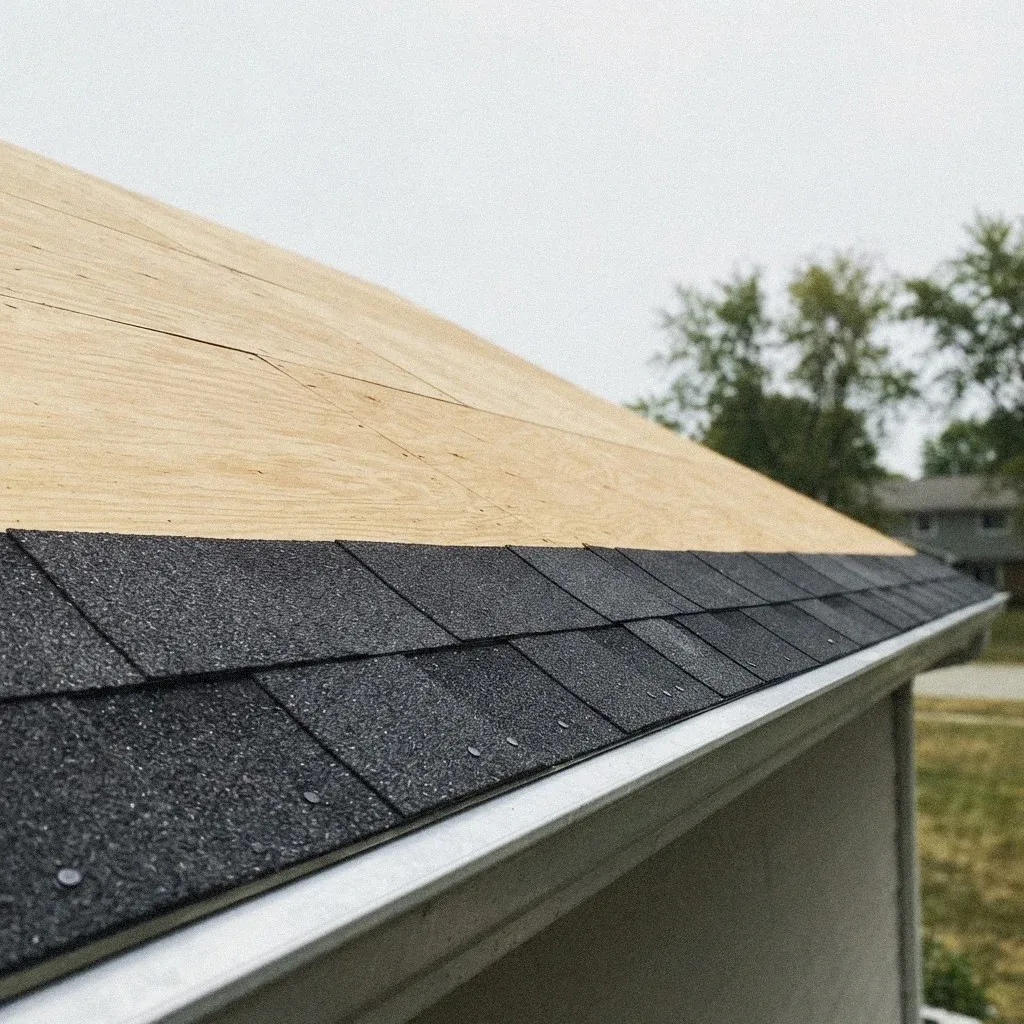
Three-tab construction is straightforward: one fiberglass mat, asphalt-saturated, coated in mineral granules, then slotted with cutouts so one strip prints as three tabs once it's on the roof. Nothing is layered or built up. That single mat is why three-tab shingles have stayed light and inexpensive for decades on Omaha homes, from older Benson bungalows to detached garages, even as laminated products became the more common choice for primary roofs.
What Laminated Shingles Add
Lamination is what turns a flat shingle into a dimensional one. A second layer of asphalt and fiberglass mat gets fused onto the base tab, then trimmed and offset so it doesn't line up edge to edge. That offset is what throws the shadow line — the shading that makes an Omaha roof read as textured from the street instead of flat. It also adds bundle weight per square, which is part of why laminated shingles carry a higher wind rating and a longer stated warranty than three-tab, before you even get to ridge cap or nailing zone differences.
Bundle Weight Per Square
Bundle weight tracks the extra material directly. A roofing square, the trade term for 100 square feet of coverage, takes noticeably more asphalt to cover with laminated shingles than with three-tab, since each laminated shingle carries two bonded layers instead of one mat. Suppliers serving Omaha contractors stock both, but a pallet of laminated bundles for a Millard or Elkhorn roof will run heavier than the same square count in three-tab, which matters for delivery and staging on a job site.
Wind Rating Differences
Wind resistance depends on the shingle's actual test rating, not the category name, and manufacturers publish that number for each product line rather than for shingle types broadly. Even so, the bonded second layer in laminated shingles adds mass and rigidity that tends to push ratings higher than typical three-tab lines reach. On a roof exposed to open sightlines near Zorinsky Lake or along West Center Road, that margin can matter more during a spring wind event than it would on a sheltered lot.
The Nailing Zone Explained
Both products carry a printed nailing zone, the strip on each shingle where the manufacturer marks where fasteners belong. Miss that band and a shingle can pull loose in gusts even if the rated wind speed was never exceeded. Laminated shingles' second layer sits over part of that zone, so installers working roofs in South Omaha or along Q Street have to be precise about depth and placement, since a nail driven too high or too low weakens the bond between the layers.
Reading The Shadow Line
The shadow line is the visual result of that bonded second layer: a narrow shaded band forms where the top piece sits slightly above the base mat, giving the roof texture instead of a flat, uniform surface. From the street in Fairacres or Blackstone, that shading is often the fastest way to tell a laminated roof from a three-tab one without getting close enough to check the cutouts. Three-tab has no equivalent shadow, since there's no second layer to cast one.
Starter Course And Ridge Cap
A ridge cap shingle finishes the peak on either roof type, but it's shaped and reinforced differently than the field shingles below it, since the ridge takes more direct sun and wind exposure than a sloped surface does. On both three-tab and laminated jobs around Papillion or La Vista, the ridge cap has to match the field shingle's manufacturer and product line, not just its color, so the granule blend and thickness read consistently from the ground.
Stated Warranty Length
Warranty length is one of the clearer gaps between the two products. Laminated shingles typically carry longer limited warranties from the manufacturer, reflecting the extra asphalt and the bonded construction that three-tab doesn't have. Three-tab warranties run shorter, in line with the single-mat build. For a homeowner comparing options on a roof near Boys Town or Ralston, that printed warranty term is a direct number to check, not a marketing claim, since it's stated on the product wrapper itself.
Why Three-Tab Still Sells
None of this has pushed three-tab out of the market entirely. It costs less per square than laminated product, and that gap still matters for a garage roof, a rental near Carter Lake, or a low-slope shed where the shadow line and higher wind rating add little practical value. Some older Omaha homes were also built with three-tab originally, and matching that look on a partial repair can outweigh the case for switching to laminated on the same slope.
Matching Shingles To A Roof
Choosing between them comes down to what the roof needs to do, not which one looks newer. A primary house roof over a finished basement in Dundee or Millard usually benefits from the added wind margin and warranty length laminated shingles offer, while a secondary structure may not need either. Checking the manufacturer's stated wind rating and warranty term for the specific product, rather than assuming based on category, is the only way to know what a given roof is actually getting.
Getting An Informed Opinion
The layer count, bundle weight, and stated warranty are printed facts, not sales talk, and any roofer working in Omaha should be able to point to them on the product wrapper or manufacturer spec sheet. Homeowners weighing a hail claim or a straightforward re-roof after a spring storm can ask the licensed pros we connect you with to walk through both shingle types before deciding what goes back on the roof.
Dealing with this in your home?
Omaha roofs fail on their own timeline. Dundee and Benson still have prewar homes with basements below, where a clogged gutter means water finding its way down, not just across. Blocks near Elkhorn or Millard face the same April hail but newer decking. Same city, same spring, different repair.