Omaha's older neighborhoods carry real tree canopy, and that canopy sheds all year. Oak leaves drop heaviest in fall, but seed pods, twigs, and smaller debris keep coming through spring storms. Dundee and Elmwood Park lots with mature oaks see roofs collect litter faster than newer subdivisions in Elkhorn, where younger trees haven't grown into the roofline yet. The debris itself isn't the hazard. Where it sits and how long it stays wet is what turns ordinary leaf drop into a covering problem.
Where Leaves Actually Pile Up
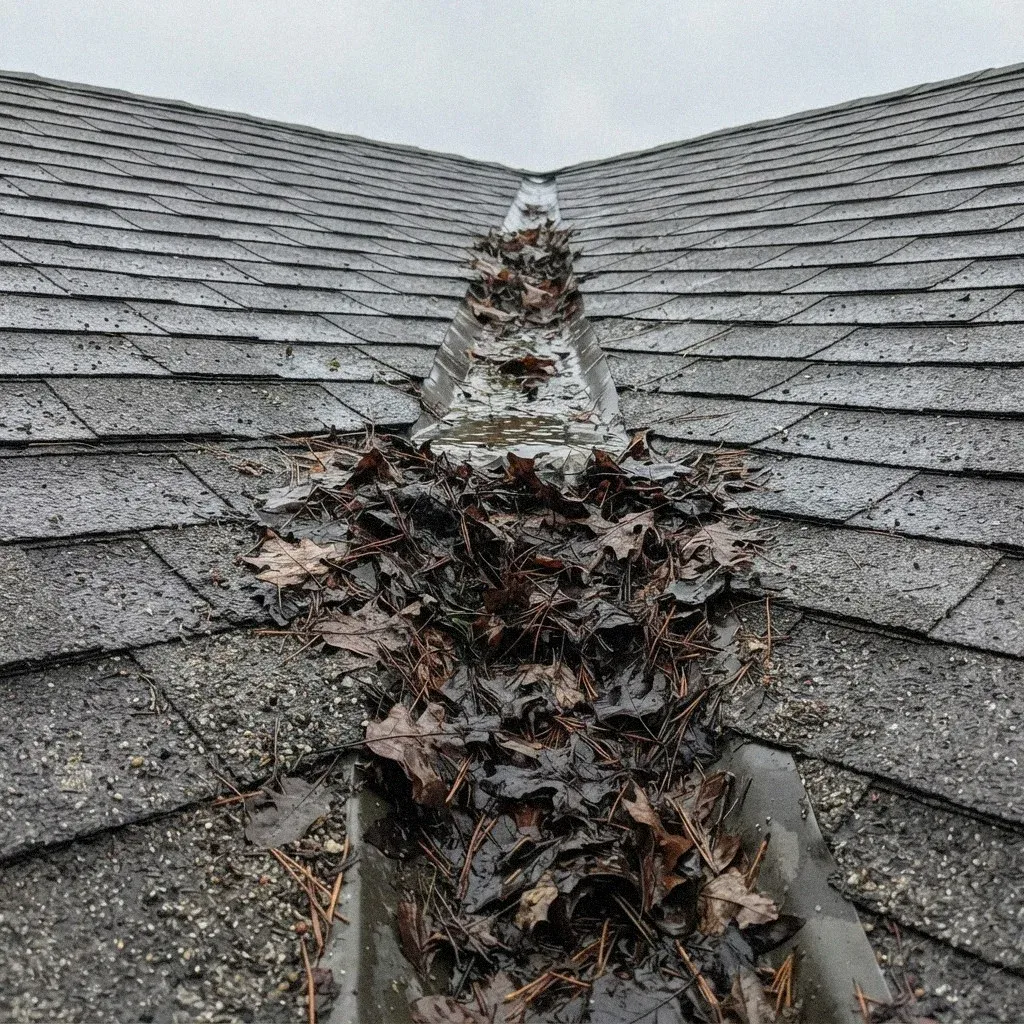
Omaha doesn't have the conifer canopy that piles needles by the cubic foot, but plenty of older blocks in Dundee, Benson, and Elmwood Park sit under mature shade trees whose leaves end up exactly where roof water already wants to go. A valley between two roof planes slows runoff enough for leaves to settle out, and a chimney or dormer creates a dead-air pocket downwind of it where windblown leaves simply stop moving and stay.
The Gutter Line Fills First
Gutters are built to move water off the roof, and that same shape catches everything else moving with it. A trough packed with wet oak leaves stops draining well before it looks full, and the overflow finds the path of least resistance instead of the downspout. On older homes throughout Midtown Omaha and Walnut Hill, that overflow often runs behind the fascia board rather than clearing the foundation the way it's supposed to.
How Wet Debris Holds Water
A pile of dry leaves on a roof does little harm. Wet leaves behave differently. They pack together, hold moisture against the shingle surface, and slow evaporation long after the rain has passed. Omaha's freeze-thaw pattern makes this worse: a soaked mat that freezes overnight expands, and repeated cycles through a Nebraska winter work that moisture deeper into seams than a single storm ever could on its own.
What Damming Leads To
When a valley or gutter outlet is blocked, water backs up instead of shedding off the slope. That standing water can work under shingle edges and flashing, particularly around chimneys and dormers where the debris already collects. Given how many older Omaha homes carry a full basement below grade, water that finds its way past the roof covering has a longer path down to cause damage than it would on a home with a slab foundation.
Granule Wear From Sitting Debris
Most Omaha homes are covered in asphalt composition shingles, which shed water through a mineral granule layer bonded to the surface. Wet leaves resting against that surface block sun and air from reaching it, so the shingle stays damp far longer than the field of the roof around it. Given enough freeze-thaw cycles through an Omaha winter, that constant dampness works into the mat underneath and shortens the life of that section faster than the rest of the roof.
Clearing Debris From the Ground
Not every bit of this work requires getting on the roof. Standing on the ground with a blower set to a low, steady stream and working the gutter line and lower roof edge from underneath can knock loose leaves free before they mat down. It works best right after a dry, windy stretch, since damp leaves that have sat for a week or two tend to cling and need to be lifted rather than blown.
Working the Roof Surface Directly
Cottonwood fluff and street-tree leaves are the debris Omaha roofs actually carry, and clumps wedged behind a chimney or packed into a valley won't shift on their own. Working from a ladder set on level ground, use a plastic-tined rake or a push broom with a long handle to break the mass apart and slide it toward the eave. Metal tools and stiff bristles catch granules and lift them off the shingle. Clear the ground-level gutter runs the same day, since loosened debris that stops there just recreates the dam it came from.
Skip the Pressure Washer Here
A pressure washer seems like an obvious shortcut for a stubborn mat of wet leaves, but the spray pattern needed to break that mat apart also drives water up under shingle tabs and around flashing seams. On an older Omaha roof, that's water heading toward a deck that may already be marginal, and on any roof it can force moisture past the underlayment in spots where it was never meant to enter from above.
Finishing at the Gutters
Clearing the roof only solves half the problem, since leaves washed down during that work tend to land straight in the gutter trough below. That trough needs to be checked and cleared on its own, along with the downspout outlets, which are the part most likely to clog first and back water up into the trough during the next rain. A garden hose run from the high end confirms whether water is actually making it out the bottom.
Overhanging Limbs Keep It Coming Back
When the same stretch of roof keeps collecting leaves every season, the cause is usually a specific limb overhanging that section, not the roof itself. Homes along older streets near Hanscom Park or Fontenelle Park, where tree cover has had decades to grow in, tend to see this more than newer construction out toward Elkhorn, where the trees are still young and the canopy hasn't closed in over the rooflines yet.
When to Call In Help
A single-story home with clear ground access around it is manageable for most Omaha homeowners with a rake, a ladder, and a calm afternoon. A steep roof pitch, a second story, or a chimney set back from the eaves changes that calculation, since the footing gets less stable exactly where the work gets more delicate. A deck that already feels soft underfoot when walked is a sign to stop and have it looked at rather than keep clearing around the problem.
Dealing with this in your home?
Omaha roofs fail on their own timeline. Dundee and Benson still have prewar homes with basements below, where a clogged gutter means water finding its way down, not just across. Blocks near Elkhorn or Millard face the same April hail but newer decking. Same city, same spring, different repair.