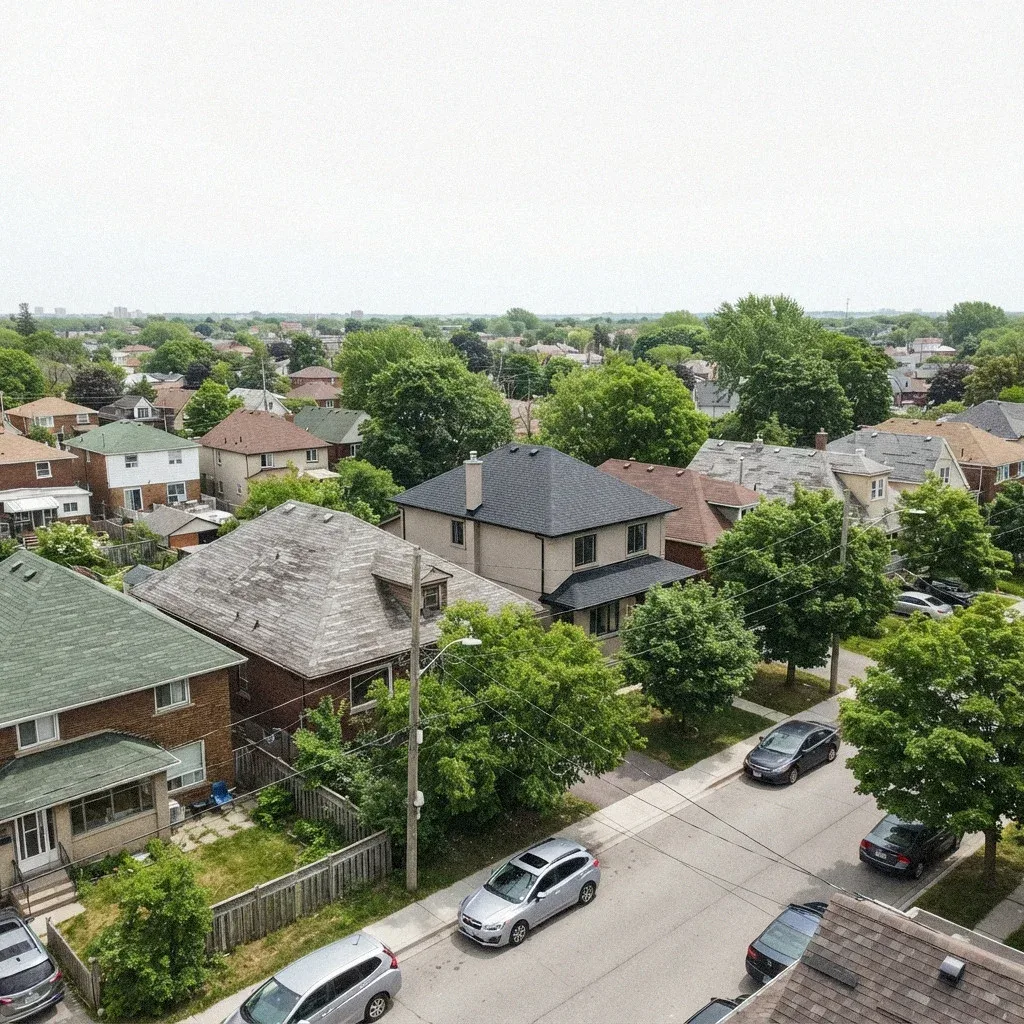
Most Omaha homeowners never touch a ladder, and a first read of the roof doesn't need one either. Stand where the driveway meets the street, or cross to the far curb, and look at each roof plane in turn. Morning or late afternoon light throws shadow lines across the shingle courses that flatten out at midday, so timing the look matters as much as where you stand. That sightline is the whole triage — no more, no less.
Sight Along the Ridge
Follow the ridge line against open sky above a neighborhood like Benson or Dundee. It should read as one continuous edge from end to end, without a dip or a hump breaking the run. A ridge that sags toward the middle, or seems to wander off level along one plane, points to something happening in the framing below it. That's a call for a licensed pro to climb up and confirm, not a guess to settle from the yard.
Look at the Shingle Courses
A shingle course is one horizontal row, and courses should stack in even bands from ridge to eave. From the sidewalk, watch for a course that drifts out of line, rises where the ones around it don't, or seems to buckle over a short stretch. That kind of break usually traces back to something moving underneath the shingles, not the shingles choosing to sit oddly on their own.
Check for Cupping and Clawing
Back away until the roof plane sits at a shallow angle to your eye, more like scanning a fence line than looking straight up. Cupping shows as shingle edges curling upward, catching a thin shadow along each tab. Clawing looks different — the edges curl up while the middle stays flat, so the shingle looks tented. Both are easier to catch in low morning or evening light across a Millard or Elkhorn roof plane.
Watch for a Bald Spot
A bald spot shows up as a patch on a roof plane where the shingle looks darker and flatter than the shingles around it, granules gone and the asphalt mat exposed underneath. From a driveway in Benson or Dundee, the sun angle matters — early morning or late afternoon light rakes across the shingle course and throws that flat patch into sharper contrast against the surrounding texture. Note the roof plane it's on, not just that it's there.
Note Streaking on Shaded Slopes
Dark streaks running down a north-facing or shaded slope are usually algae, not soil, and they follow the path water takes down the shingle course. Moss reads differently — a raised, greenish patch rather than a streak, often near a valley or chimney where moisture lingers longer. On older homes in Florence or Minne Lusa, a streaked slope is common enough to note but not automatically a repair.
Watch the Downspout Outlets
During a hard Omaha downpour, watch what happens at each downspout outlet along the fascia. A steady flow means the gutter run feeding it is clear and sloped right. A trickle, or water pouring over the gutter's edge instead of through the outlet, usually means a clog or a low spot holding water above it. That backup doesn't start at the downspout — it starts higher on the roof plane, and the outlet is just where it becomes visible.
Check the Soffit and Siding
Look at the soffit and the top rows of siding just under the roof edge. A dark or rust-colored streak trailing down from above often traces back to an overflowing gutter or a flashing gap higher up the slope. On older Omaha housing stock, with brick or frame walls and a basement below, that kind of staining is worth noting even if it looks minor, since water finding a path down the wall can eventually find one down toward the foundation.
Look for Buildup at the Drip Edge
The drip edge sits along the roof's lower border, right above the fascia and gutter apron, and from the street you're not checking the metal itself — you're checking what has piled up against it. Granules washed down from higher shingle courses collect there, along with grit from cupping or clawing shingles breaking down. A downspout outlet or gutter apron choked with that dark grit, viewed from below, often tells you more than the shingles do.
Bring a Pair of Binoculars
Binoculars turn a guess into something specific. Aim them at the ridge line first, checking for a wavy or uneven silhouette against the sky, then work down each roof plane toward the eaves. Flashing around any roof penetration, streaking patterns running down toward the soffit, and staining creeping onto the siding below all read differently once magnified. A homeowner in Millard or Elkhorn can spot a lot this way before ever mentioning it to anyone.
What the Ground Can't Show You
Everything above is a starting point, not a full picture. A roof plane facing away from the street, a valley tucked behind a taller section, or flashing around a chimney simply isn't visible from a driveway in Gifford Park or anywhere else. A roof that looks clean from the curb can still have a soft spot nobody's seen yet, and one with a few bald spots can still have years left in it.
Turning a Guess Into an Answer
If something noticed from the yard keeps nagging at you — a wavy ridge line near Aksarben Village, a streaked slope off Center Street, a stained soffit on a Millard bungalow — the next step is to narrow it down. Note which plane, which side of the house, and what the light was doing when you saw it. That detail is what turns a vague worry into something a licensed pro can check quickly once they're on site.
Dealing with this in your home?
Omaha roofs fail on their own timeline. Dundee and Benson still have prewar homes with basements below, where a clogged gutter means water finding its way down, not just across. Blocks near Elkhorn or Millard face the same April hail but newer decking. Same city, same spring, different repair.