Metal roofing gets talked about as one product, and on an Omaha street it is really two. Standing seam hides its fasteners under a raised, folded seam and lets the panel move as it heats and cools. Exposed-fastener panel is screwed through the face into the deck, with a rubber washer under each screw head doing the waterproofing. Almost everything else that separates them follows from that one difference.
Standing Seam, Defined by Its Seam
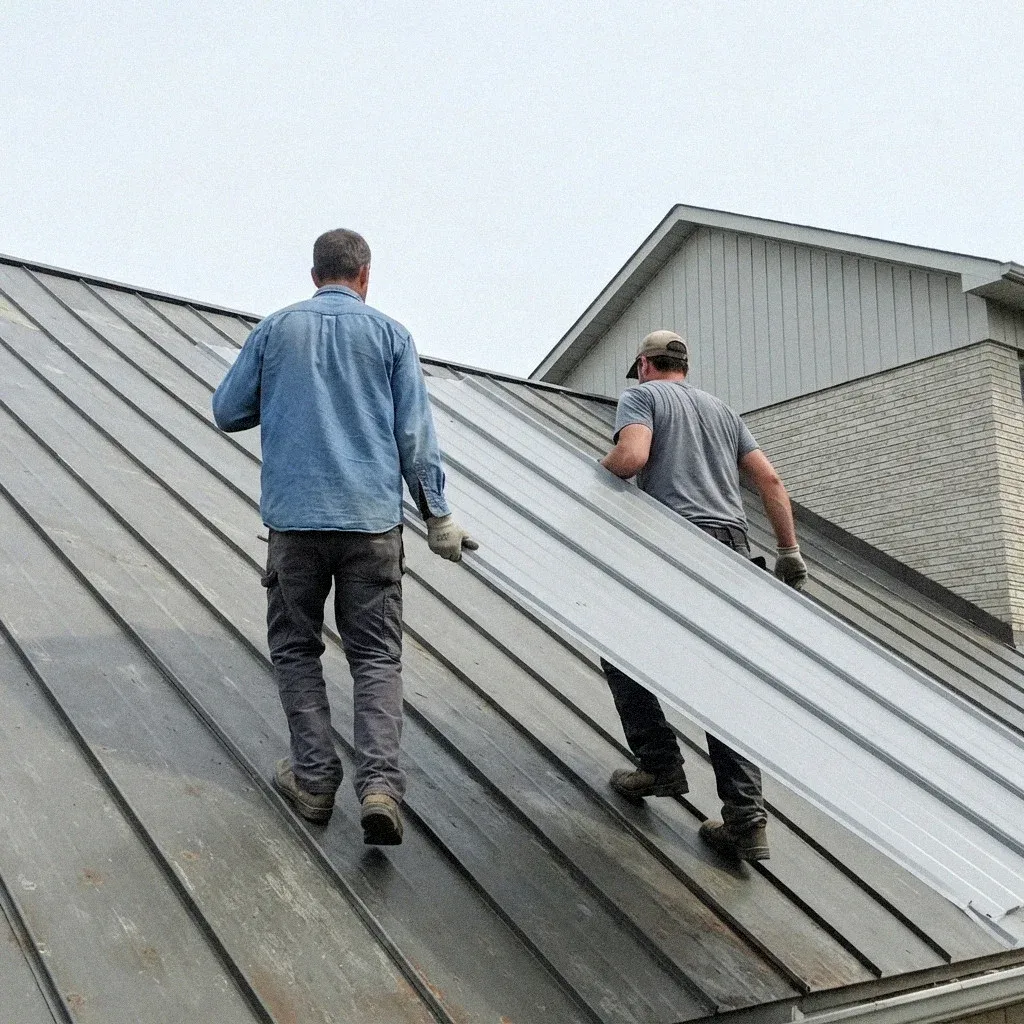
Standing seam is a family of metal roofing built from long panels connected by a raised, vertical seam that runs from the ridge down to the eave. That seam is the identifying feature, and it's mechanically seamed or snapped together with no exposed screw anywhere on the visible panel. Underneath, hidden clips hold the panel to the deck, which is why the surface reads as one continuous plane from the street in front of a Benson or Aksarben Village home.
The Concealed Clip Underneath
A concealed clip is the small metal bracket fastened to the roof deck that grips the panel edge from below, out of sight once the seam closes over it. That clip lets the panel move slightly as temperatures shift, rather than locking it rigid to the deck. It's the reason standing seam avoids the puncture points that an exposed-fastener system depends on, and it's the detail worth asking about if a bid mentions standing seam without naming how the clip is attached.
Snap-Lock Versus Mechanically Seamed
Standing seam comes in two forms. A snap-lock panel clips together by hand and suits a straightforward roof with a decent pitch. A mechanically seamed panel is folded closed with a powered tool once it is laid, either once or twice, and that folded seam is what makes it suitable for a low slope or a roof that carries standing snow. The second costs more to install and it is the stronger detail.
What an Exposed Panel Looks Like
From the ground the giveaway is a line of small dots running across each panel every foot or so. Those are screw heads, and there are hundreds of them on a roof. The panels are usually narrower than standing seam and the ribs are lower and more frequent. It is the cheaper of the two by a wide margin, and it is what most Omaha shops and outbuildings are covered with.
The Gasket That Keeps Screws Dry
On an exposed-fastener roof, every screw relies on a rubber washer squeezed between its head and the panel. Get the torque right and it seals; overtighten it and the washer deforms; leave it loose and it never seals at all. Those washers age in sunlight and in temperature swings, which this climate supplies in both directions, so a panel roof needs its fasteners checked and often re-driven somewhere around fifteen years.
How Thermal Movement Plays Out
Metal panels lengthen and shorten as temperatures swing between a January morning near 17 degrees and a July afternoon well above 90. Standing seam is built to let that thermal movement happen along the seam, since the panel floats under its clips instead of being locked in place. An exposed-fastener panel is fixed at every screw, so that same expansion gets absorbed by the gasket and the hole itself, which is why those washers matter so much over time.
Reading Oil Canning on a Roof
Oil canning is the gentle waviness you sometimes see along a metal panel in low sun. It is a cosmetic effect of the way flat metal behaves once it has been formed and fixed, not a fault, and no manufacturer warrants against it. Wider, flatter panels show it more, and so do dark colors and a roof seen at a shallow angle from the street. Striations or a pencil rib in the panel reduce it.
Panel Rib and Seam Height Compared
Looking at the raised profile is usually the quickest way to sort the two apart without any other clues. A standing seam panel has a tall seam height, often an inch and a half or more, running only at the panel edges where two sheets meet. An exposed-fastener panel has a shorter, evenly spaced panel rib repeating across the whole width, whether it's a squared R-panel profile or a rounded corrugated pattern, with screws visible in between.
What Closure Strips Do
At the ridge and the eave, a metal roof has a gap the exact shape of its own profile, and a closure strip is the foam or metal piece that fills it. Leaving one out is the commonest way a metal roof lets wind-driven rain and blowing snow in, and neither shows up as an ordinary leak. On a roof where snow drifts and blows, the closures matter as much as the panels do.
Where Each System Tends to Show Up
Standing seam shows up more on architecturally driven builds, porch roofs, and additions where a homeowner wants a smooth, uninterrupted look, the kind you'll spot on newer construction out toward Elkhorn or a remodel in Field Club. Exposed-fastener panels turn up more often on garages, outbuildings, and pole barns in and around Bennington or Waterloo, where the lower material and labor cost matters more than a seamless appearance from the curb.
Telling Them Apart From the Curb
Stand across the street and look for fasteners. No visible screw heads, and a raised seam standing proud of the panel, means standing seam. Rows of small dots and a lower, more frequent rib means exposed fastener. If you can see both on one property, it is usually standing seam on the house and panel on the garage, which is a reasonable way to spend the money.
Dealing with this in your home?
Omaha roofs fail on their own timeline. Dundee and Benson still have prewar homes with basements below, where a clogged gutter means water finding its way down, not just across. Blocks near Elkhorn or Millard face the same April hail but newer decking. Same city, same spring, different repair.