A fall storm rolling across Omaha rarely announces the damage it's doing while it's happening. The wind sounds loud, the rain sounds heavy, and the roof itself stays quiet. What actually changes up there — a lifted tab, a struck vent, a gutter losing the fight with wet leaves — usually isn't visible from a bedroom window on Dodge Street or from a backyard in Benson. It shows up later, once the sky clears and somebody finally looks up.
Uplift at Rake Edges and Hips
Wind moving across a flat roof plane doesn't cause much trouble. The trouble starts at rake edges and hips, where the air has nowhere to go but around a corner, and that sudden change in direction pulls upward on whatever shingle happens to be there. This is wind uplift, and it's strongest exactly where a roof has the least reinforcement — the outer edges — which is why storm damage in Omaha so often starts at the perimeter and works inward.
Shingles That Crease Instead of Fly
A blown-off shingle is easy to spot from the driveway. A creased one isn't. Wind gets under a tab and bends it upward without tearing the seal loose, and the shingle settles back down looking mostly normal. The crease is a permanent weak point now, a line where the shingle will crack the next time it flexes. Homeowners in Dundee or Millard walking the yard after a storm often find granules before they find any actual missing shingle.
Branch Strikes Across the Metro
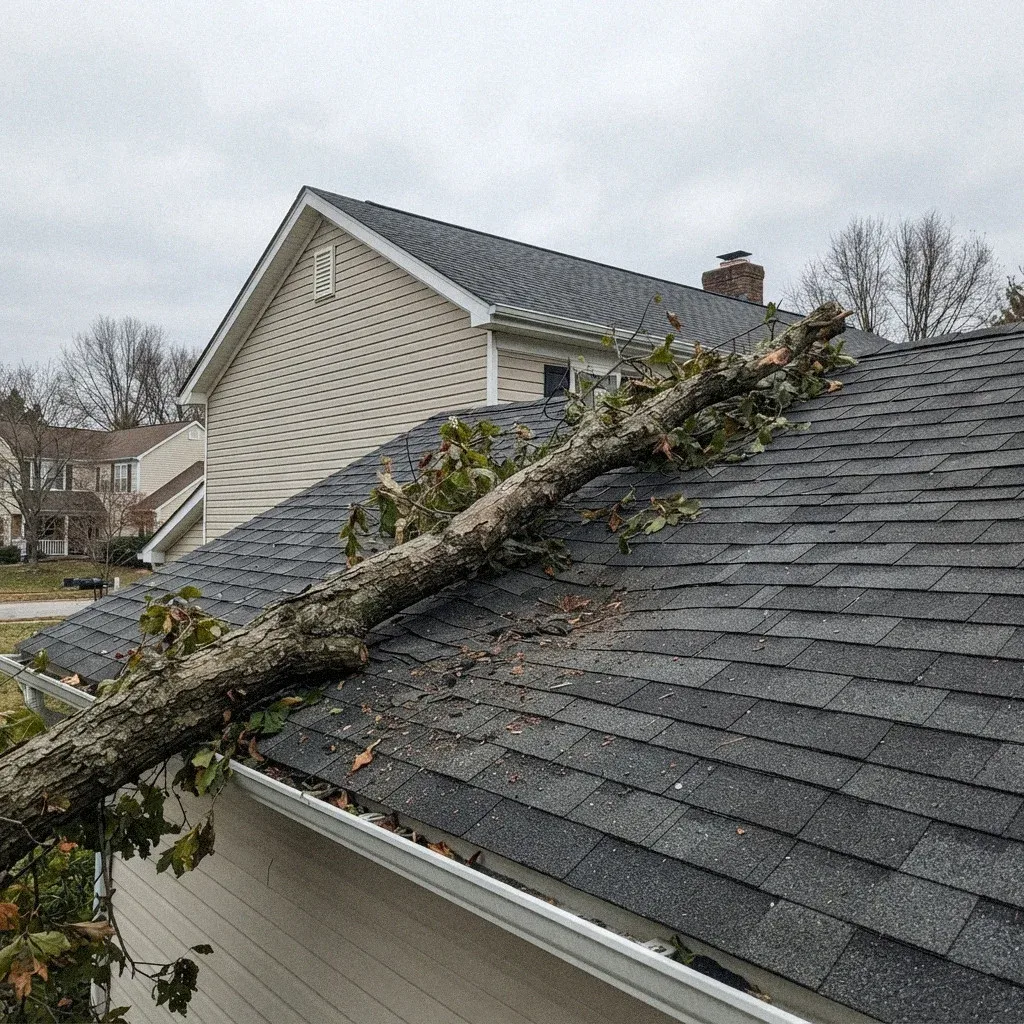
Omaha's older neighborhoods carry a lot of mature tree canopy, and a fall windstorm treats that canopy as loose material. Limbs come down over Elmwood Park, over Fontenelle Park, over the tree-lined streets of Field Club and Happy Hollow, and some of them land on a roof on the way. A direct branch strike can crack a shingle or punch through decking. More often it leaves an impact bruise — a soft dent that doesn't look serious until the shingle starts failing there months later.
Debris Settling Into Valleys
Once the wind dies down, the roof keeps whatever landed on it. Leaves, twigs, and broken branch material collect in valleys and pile against the uphill side of chimneys, skylights, and plumbing vents. In neighborhoods like Bemis Park or Gifford Park, where the canopy sits close over the roofline, that debris field can be thick enough to hold moisture against the shingles for days after the rain itself has stopped.
Gutters Losing to the Runoff
A fall storm in Omaha usually brings two problems at the same time: a fast, heavy rain and a fresh batch of leaves knocked loose by the same wind that dumped the rain. Gutters already half full from the week before fill the rest of the way fast, and an overflowing gutter sends water down the siding instead of away from the house. With full basements standard in most Omaha-area homes, water that isn't moving away from the foundation is a bigger problem here than a house on a slab.
Wind-Driven Rain and Weak Flashing
Loose flashing around chimneys and roof-to-wall joints causes trouble that's easy to miss during a quick look from the ground. That metal is set up to handle rain falling straight down, not water pushed sideways by a gust off the Missouri River valley. A hip or valley seam that held fine all summer can work loose during one windy, wet night, letting driven rain track under the shingle field toward the deck below.
Ridge Caps Taking the Worst of It
Hips and the ridge running along a roof's peak take the worst of a fall gust because wind splits and accelerates right at that seam. The cap pieces there are cut smaller than field shingles, with less surface bonded down, so a sustained blow out of the west can work them loose one nail at a time. Once a ridge cap lifts, the ridge vent underneath is exposed, and rain starts entering through the highest point instead of running off it.
Older Roofs Built to Older Standards
Plenty of homes in Omaha's older neighborhoods — Kountze Place, Near North Side, parts of Walnut Hill — were roofed decades before current wind-resistance expectations for shingles existed. These roofs weren't built wrong for their time, but a fastening pattern or shingle weight that held up fine in an earlier era doesn't always hold up the same way against today's storms, especially after years of freeze-thaw cycling have already loosened nail seats and dried out sealant strips.
Low-Slope Sections in the Wind
Not every Omaha roof is one continuous pitched surface. Additions, porches, and some newer builds around Elkhorn and Aksarben Village carry a low-slope section finished in membrane rather than shingle. Wind behaves differently across a low-slope plane — it can get under a membrane seam and work it loose the same way it lifts a shingle tab, just with less give in the material and less warning before a seam actually separates.
Reading the Damage From the Yard
Checking a roof after wind and rain move through Omaha doesn't call for a ladder. Start in the yard: granules collecting near downspouts or shingle fragments scattered under a tree point to a debris field worth tracing back. From the driveway, sight along the rake edge for a shingle tab sitting proud of its neighbors, then check gutters for sagging sections pulled loose by trapped water or branch strikes.
Damage That Shows Up Later
A roof can look fine right after a storm and still be compromised. A creased shingle often stays sealed through a dry week before a later gust finally pulls it free, and slow drips along an interior wall near Dundee or Benson can take days to reach a visible stain. Granule loss thins the shingle's sun protection gradually rather than all at once, so the real toll from an October system sometimes shows up in December instead.
Dealing with this in your home?
Omaha roofs fail on their own timeline. Dundee and Benson still have prewar homes with basements below, where a clogged gutter means water finding its way down, not just across. Blocks near Elkhorn or Millard face the same April hail but newer decking. Same city, same spring, different repair.