A shingle field is built to shed water on its own, so when a roof over a Dundee bungalow or a newer Elkhorn build starts leaking, the shingles are rarely the reason. The trouble sits wherever the surface changes — a pipe coming through the deck, two slopes meeting, a wall rising out of the roof plane. Omaha's freeze-thaw winters and spring hail work hardest on those junctions, not on the open field between them.
Pipe Boots and Vent Stacks
A bathroom or kitchen vent pushes through the roof deck as a pipe, and that opening gets covered with a boot, a molded collar that seals against the pipe while its base ties in under the shingle courses above and over the ones below. The rubber gasket at the top is usually the first material on an Omaha roof to give out, since years of freeze-thaw cycling crack and shrink it long before the shingles around it show wear.
Valleys and Slope Intersections
A valley forms wherever two roof planes meet at an angle, and every drop of rain that lands on either side funnels down that seam. On the older gabled rooflines common in Dundee and Florence, valleys often carry more runoff than any gutter downspout below them. If the underlayment beneath the valley metal wasn't lapped correctly, or granules have worn thin from age, water finds the seam instead of running past it, and it enters the deck long before a ceiling stain shows anything upstairs.
Headwall and Sidewall Flashing
Anywhere a roof plane meets a wall instead of open air, water needs a different path than it takes on open shingle. Headwall flashing covers the spot where the slope dead-ends straight into a wall; sidewall flashing runs along a wall that a slope simply passes beside as it continues downhill. The sidewall condition uses step flashing, individual metal pieces layered with each shingle course so the joint moves with the roof instead of relying on one long strip and a bead of sealant.
Chimney Counterflashing Wear
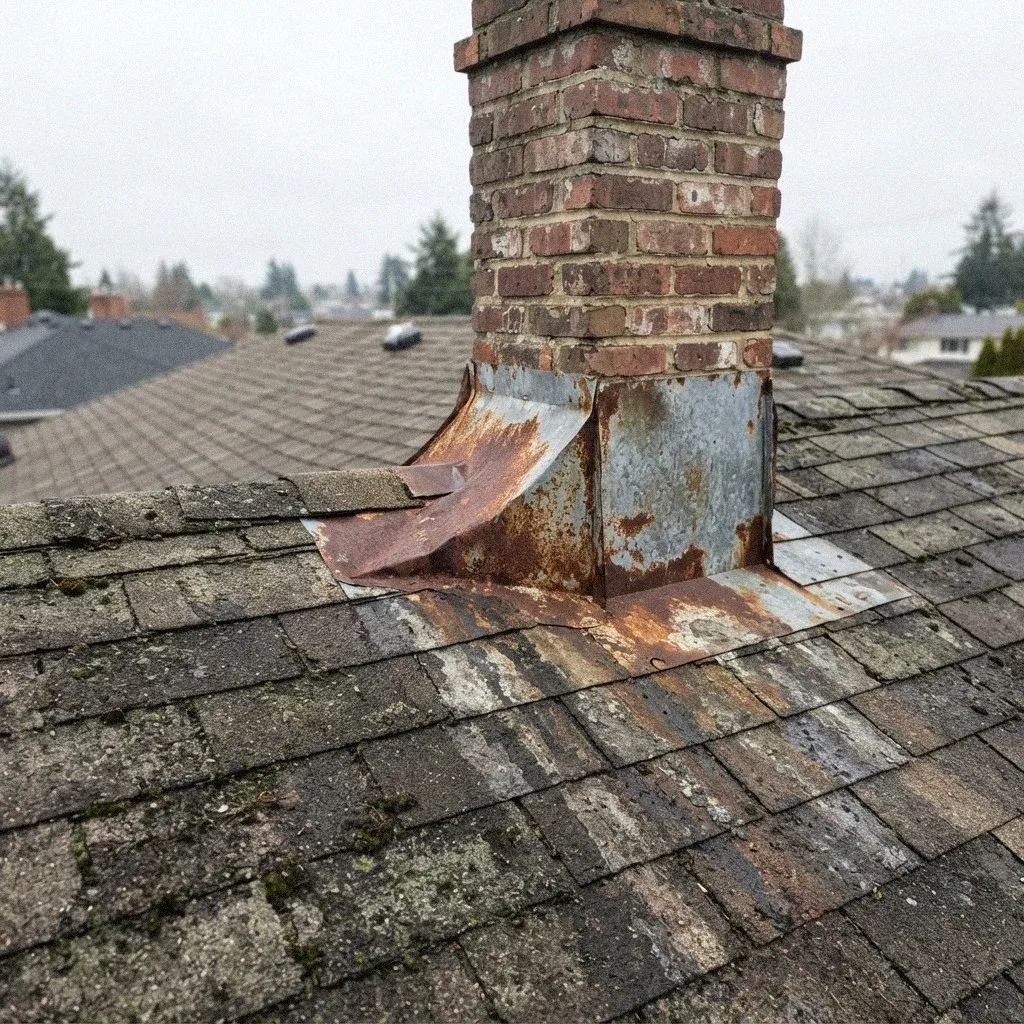
A chimney depends on two separate pieces of flashing working together. Base flashing sits against the deck and shingles; counterflashing is set into the mortar joints above it and bends down to cover the base piece. Masonry shifts slightly with Omaha's freeze-thaw cycling, and that movement opens a gap between the two layers. Once that gap opens, the chimney becomes one of the most common leak sources on houses in Florence and other older parts of the city.
Skylight Curb Seal Failure
A skylight curb is the raised frame the unit sits on, flashed piece by piece on each side to match the pitch it was built for. That flashing is sized to one roof and one skylight model, so a mismatched replacement or a curb that's shifted slightly leaves a gap no amount of sealant fixes for long. Homes in Aksarben Village and other neighborhoods with added skylights see this show up as a slow drip rather than a sudden leak.
Kick-Out Flashing Gaps
A sidewall run has to end somewhere, and where it meets a gutter or eave, a plain strip of step flashing will dump water straight down the wall face instead of out into the open. Kick-out flashing is the bent piece added at that lower corner to redirect the flow outward. Leave it out, and Omaha's wind-driven rain finds the gap between wall and fascia, soaking the sheathing behind the siding without ever showing up as a stain on the roof itself.
Roof-To-Wall Transitions Get Skipped
Beyond a simple sidewall, a roof-to-wall transition happens anywhere a lower roof section ties into a taller wall carrying siding, brick, or a second story above it, a layout common on split-level homes across West Omaha. These transitions need flashing sized for the specific materials meeting there, not a generic strip. Because the joint is often hidden behind trim or siding, a gap here can leak for a long stretch before anyone notices water inside.
Eaves, Rakes, and Drip Edge
Drip edge is the metal strip along eaves and rakes that keeps runoff moving away from the fascia and wall below. Without it, water can creep backward under the shingles and soak the wood decking over time. Omaha's older homes in Dundee or Benson sometimes lack this piece entirely, since it wasn't standard on every original build. Freeze-thaw cycling through a Nebraska winter makes that gap worse, cracking underlayment at the roof's edge where it's least protected.
Loosening Exposed Fasteners
An exposed fastener is any nail or screw left visible on the surface rather than hidden under an overlapping course, common on vent flanges, ridge caps, and some metal roofing sections. Each one is sealed with a washer or dab of sealant that ages faster than the metal around it. Once that seal shrinks or cracks, the fastener hole becomes a direct opening straight through the deck, something inspectors see often on older South Omaha roofs.
Underlayment as a Backup
None of this assumes the shingles are watertight on their own. Underlayment is the layer between the deck and the shingles, and it catches whatever gets past a flashing joint before it reaches the wood below. On a well-built Omaha roof, that layer is what turns a small flashing failure into a slow, contained problem instead of an immediate leak, buying time between when water gets in and when it actually shows up inside.
Why These Joints Matter Most
Looking at this list together, the pattern is plain: the shingle field itself is rarely where a roof actually lets go. Pipe boots, valleys, headwalls, sidewalls, chimneys, skylights, kick-outs, drip edge, and fasteners are where the failures happen, because each one depends on a joint holding rather than a flat surface. A roof in Elkhorn or Ralston with sound flashing at every one of these points will usually outlast the shingles covering it.
Dealing with this in your home?
Omaha roofs fail on their own timeline. Dundee and Benson still have prewar homes with basements below, where a clogged gutter means water finding its way down, not just across. Blocks near Elkhorn or Millard face the same April hail but newer decking. Same city, same spring, different repair.